
Cardrake research · 30th anniversary
30 years of Pokémon TCG,
in data
The Pokémon Trading Card Game turns 30 this year, and the 30th Celebration set arrives worldwide on September 16, 2026. To mark it, we counted the whole game, every English set, card, rarity, and artist credit, and matched it all against current market prices from our database. This page is what came out.
Catalog 2026-07-20 · Prices 2026-08-02 · English releases only · Methodology
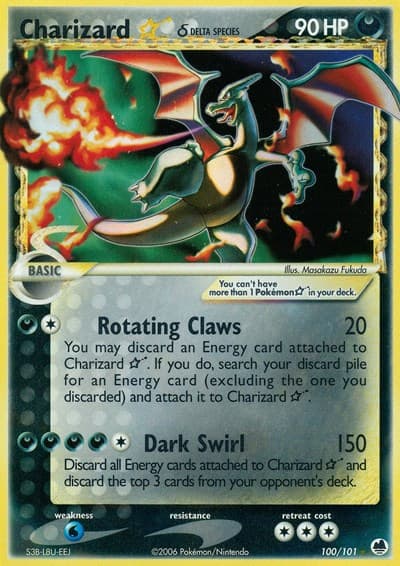
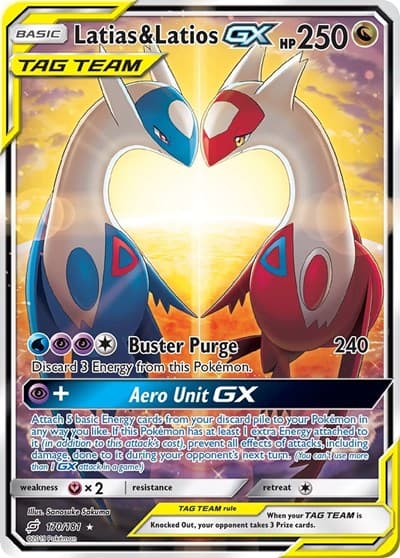
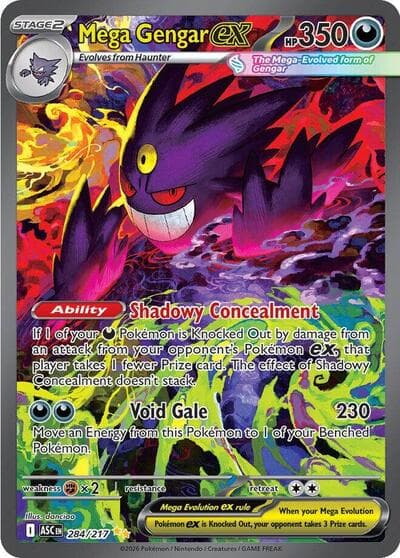
The most valuable card of each collecting decade
20,493
English cards
163
Sets
398
Credited illustrators
1,025
Pokémon species on cards
The count
How many Pokémon cards are there?
There are 20,493 unique English cards, released across 163 sets between January 1999 and today. You will find other counts online, anywhere from 18,000 to 21,000, and the spread comes down to what each site treats as a card. We count one catalog entry per set number, which means a reverse holo does not count twice but a secret-rare alternate art does, since it carries its own number. Promo sets are included in the total, while Japanese exclusives are left out entirely because our catalog covers English releases.
Of those cards, 17,279 are Pokémon, 2,780 are Trainers, and 434 are Energy cards. Strip out the 20 promo sets and the mainline count is 18,966 cards in 143 expansions.
What the 20,493 are
- 17,279 Pokémon
- 2,780 Trainers
- 434 Energy
One catalog entry per set number. A reverse holo does not count twice; a secret-rare alternate art does.
01 — Output
The firehose opened in 2020
The game needed its first twelve years to release 5,399 cards, then put out 3,415 in the last three alone. A typical year in the mid-2010s brought around 640 cards; the Sword & Shield years averaged over 1,000, and output has stayed there since. 2026 is at 864 cards through mid-year, with two sets still to come.
Peak: 1,710 cards across 9 sets in 2023 · dimmer bars are before 2020
| Year | Cards | Sets |
|---|---|---|
| 1999 | 284 | 4 |
| 2000 | 588 | 5 |
| 2001 | 159 | 3 |
| 2002 | 397 | 4 |
| 2003 | 673 | 5 |
| 2004 | 426 | 4 |
| 2005 | 474 | 4 |
| 2006 | 417 | 5 |
| 2007 | 552 | 5 |
| 2008 | 458 | 4 |
| 2009 | 533 | 5 |
| 2010 | 438 | 5 |
| 2011 | 524 | 5 |
| 2012 | 516 | 5 |
| 2013 | 781 | 7 |
| 2014 | 494 | 4 |
| 2015 | 576 | 5 |
| 2016 | 860 | 7 |
| 2017 | 737 | 5 |
| 2018 | 835 | 5 |
| 2019 | 1,473 | 8 |
| 2020 | 918 | 5 |
| 2021 | 1,204 | 8 |
| 2022 | 1,051 | 9 |
| 2023 | 1,710 | 9 |
| 2024 | 1,225 | 6 |
| 2025 | 1,326 | 8 |
| 2026 | 864 | 14 |

02 — Set size
Set sizes keep growing, and the growth is secret rares
The amber band is the part printed checklists tend to forget. The binder planner lays out any set page by page, secret rares included, with live prices per card.
Jungle had 64 cards and not a single secret rare, while Surging Sparks prints 191 on the pack and runs to 252 once the secret rares are counted. Averaged out, sets released since 2024 print 127 cards and contain 186, so nearly a third of the modern master set sits above the number on the box. Over 30 years the printed set grew by about two thirds, but the master set, the thing completionists actually chase, grew two and a half times.
- Printed on the pack
- Secret rares
| Year | Printed | Secret rares | Total |
|---|---|---|---|
| 1999 | 76 | 0 | 76 |
| 2000 | 117 | 0 | 117 |
| 2001 | 52 | 1 | 53 |
| 2002 | 127 | 3 | 130 |
| 2003 | 119 | 15 | 134 |
| 2004 | 104 | 2 | 106 |
| 2005 | 110 | 8 | 118 |
| 2006 | 83 | 0 | 83 |
| 2007 | 123 | 0 | 123 |
| 2008 | 113 | 2 | 115 |
| 2009 | 101 | 5 | 106 |
| 2010 | 103 | 0 | 103 |
| 2011 | 102 | 3 | 105 |
| 2012 | 100 | 3 | 103 |
| 2013 | 88 | 3 | 91 |
| 2014 | 121 | 2 | 123 |
| 2015 | 112 | 2 | 114 |
| 2016 | 97 | 2 | 99 |
| 2017 | 125 | 17 | 142 |
| 2018 | 148 | 15 | 163 |
| 2019 | 150 | 15 | 165 |
| 2020 | 168 | 15 | 183 |
| 2021 | 157 | 14 | 171 |
| 2022 | 106 | 11 | 117 |
| 2023 | 149 | 38 | 187 |
| 2024 | 136 | 68 | 204 |
| 2025 | 124 | 58 | 182 |
| 2026 | 119 | 47 | 166 |

03 — Rarity
The rarity explosion
The Base era got by with 7 rarities, essentially common, uncommon, rare, a holo, and a couple of promo stamps, while Sword & Shield peaked at 18. Illustration Rares, Special Illustration Rares, Hyper Rares, Trainer Gallery cards, ACE SPECs, and the two new rarities arriving with 30th Celebration all slice the pull table thinner. Where rarity used to describe how hard a card was to pull, it now also tells you which of several parallel chase ladders the card sits on.
- Used since the Base era
- Added since
| Era | Distinct rarities | Used since the Base era | Added since |
|---|---|---|---|
| Base | 7 | Common, Uncommon, Rare, Rare Holo, Promo, Holo Rare, Secret Rare | None |
| Gym | 4 | Common, Uncommon, Rare, Rare Holo | None |
| Neo | 6 | Common, Uncommon, Rare, Rare Holo, Holo Rare, Secret Rare | None |
| E-Card | 6 | Common, Uncommon, Rare, Rare Holo, Holo Rare, Secret Rare | None |
| EX | 6 | Common, Uncommon, Rare, Holo Rare, Secret Rare | Ultra Rare |
| Diamond & Pearl | 8 | Common, Uncommon, Rare, Promo, Holo Rare, Secret Rare | Ultra Rare, Shiny Holo Rare |
| Platinum | 7 | Common, Uncommon, Rare, Holo Rare, Secret Rare | Ultra Rare, Shiny Holo Rare |
| HeartGold & SoulSilver | 7 | Common, Uncommon, Rare, Promo, Holo Rare | Ultra Rare, Shiny Holo Rare |
| Black & White | 8 | Common, Uncommon, Rare, Promo, Holo Rare, Secret Rare | Ultra Rare, Rare Ace |
| XY | 9 | Common, Uncommon, Rare, Promo, Holo Rare, Secret Rare | Ultra Rare, Rare BREAK, Rare Ultra |
| Sun & Moon | 13 | Common, Uncommon, Rare, Rare Holo, Promo, Holo Rare, Secret Rare | Ultra Rare, Shiny Holo Rare, Rainbow Rare, Prism Rare, Rare Ultra, Rare Holo GX |
| Sword & Shield | 18 | Common, Uncommon, Rare, Rare Holo, Promo, Holo Rare, Secret Rare | Ultra Rare, Rare Holo V, Shiny Holo Rare, Rare Holo VMAX, Classic Collection, Rare Holo VSTAR, Rare Ultra, Radiant Rare, Amazing Rare, Rare Rainbow, Rare Secret |
| Scarlet & Violet | 15 | Common, Uncommon, Rare, Promo, Holo Rare | Illustration Rare, Ultra Rare, Double Rare, Special Illustration Rare, Shiny Rare, Hyper Rare, ACE SPEC Rare, Shiny Ultra Rare, Code Card, Black White Rare |
| Mega Evolution | 11 | Common, Uncommon, Rare, Promo, Holo Rare | Ultra Rare, Illustration Rare, Double Rare, Special Illustration Rare, Mega Hyper Rare, Mega Attack Rare |

04 — The mascot race
Charizard vs Pikachu, settled with a count
Pikachu wins, 164 cards to 107, and the race was never close. Pikachu led 17 to 12 by the end of the vintage era, stretched the gap to 38 against 22 by 2010, and the promo years widened it from there. The mascot gets a card in nearly everything, including one in every pack of the 30th Celebration set.
- Pikachu · 164 cards
- Charizard · 107 cards
| Year | Pikachu (cumulative) | Charizard (cumulative) |
|---|---|---|
| 1999 | 9 | 1 |
| 2000 | 13 | 5 |
| 2001 | 13 | 5 |
| 2002 | 15 | 10 |
| 2003 | 17 | 12 |
| 2004 | 19 | 13 |
| 2005 | 20 | 13 |
| 2006 | 24 | 15 |
| 2007 | 27 | 18 |
| 2008 | 29 | 19 |
| 2009 | 35 | 22 |
| 2010 | 38 | 22 |
| 2011 | 40 | 22 |
| 2012 | 42 | 23 |
| 2013 | 48 | 28 |
| 2014 | 50 | 35 |
| 2015 | 52 | 35 |
| 2016 | 81 | 50 |
| 2017 | 84 | 52 |
| 2018 | 84 | 53 |
| 2019 | 111 | 70 |
| 2020 | 116 | 75 |
| 2021 | 124 | 77 |
| 2022 | 133 | 85 |
| 2023 | 143 | 99 |
| 2024 | 150 | 101 |
| 2025 | 152 | 105 |
| 2026 | 164 | 107 |

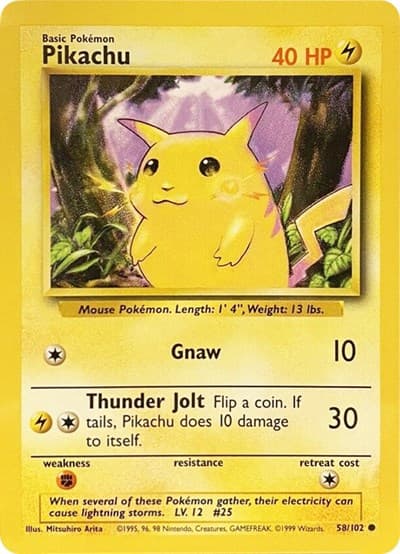
Where the count started
Base Set Pikachu (1999), painted by Mitsuhiro Arita. 163 more Pikachu cards followed it.
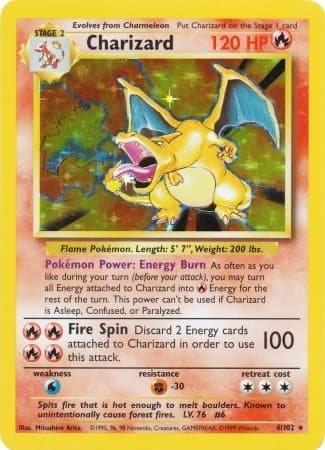
Its rival, also Arita's
Base Set Charizard (1999), the card that made Charizard collecting a hobby of its own. Around $998 raw today.
The most printed Pokémon
The top two need no explanation, but third place goes to Unown of all Pokémon, which reached 95 cards by getting one for every letter form across several sets and quietly out-printed Mewtwo, Eevee, and every starter along the way.
| Pokémon | Cards |
|---|---|
| Pikachu | 164 |
| Charizard | 107 |
| Unown | 95 |
| Mewtwo | 85 |
| Eevee | 80 |
| Raichu | 70 |
| Lucario | 59 |
| Rayquaza | 59 |
| Meowth | 57 |
| Gyarados | 57 |

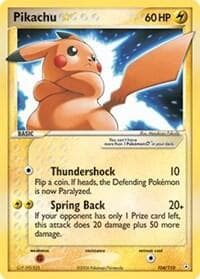
Pikachu's most valuable card
The most valuable of Pikachu's 164 cards: Pikachu Star from Holon Phantoms (2006), $3,200 at market.
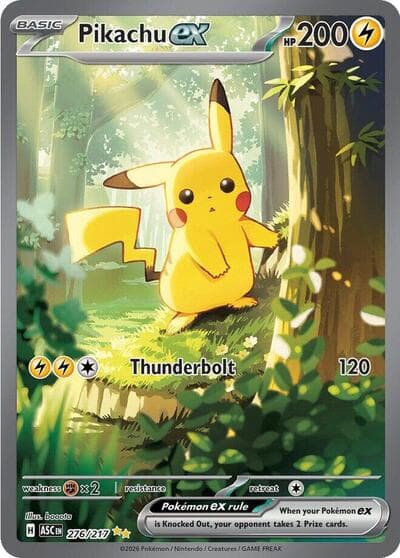
And its runner-up
20 years newer: Pikachu ex from Ascended Heroes (2026), $1,160 at market.
05 — Illustrators
398 artists, one game
398 credited illustrators have drawn English Pokémon cards. 5ban Graphics leads with 1,625 credits. Mitsuhiro Arita, who painted the original Base Set Charizard and Pikachu, has 720 credits spanning 28 years, from 1999 to 2026.
| Illustrator | Cards credited |
|---|---|
| 5ban Graphics | 1,625 |
| Ken Sugimori | 1,090 |
| Mitsuhiro Arita | 720 |
| Kagemaru Himeno | 649 |
| Kouki Saitou | 641 |
| Masakazu Fukuda | 468 |
| Ryo Ueda | 462 |
| Atsuko Nishida | 402 |
| Midori Harada | 349 |
| Shin Nagasawa | 302 |

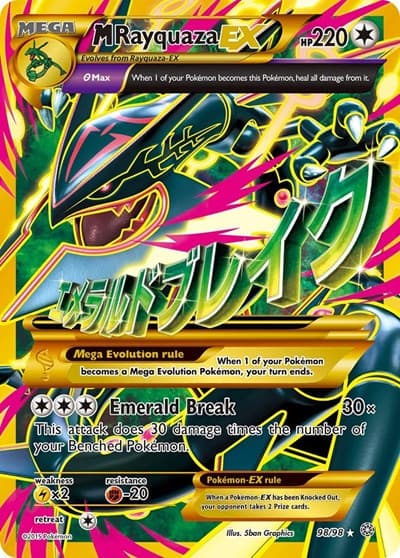
5ban Graphics, best of 1,625
M Rayquaza EX Shiny Full Art (XY - Ancient Origins, 2015), $1,070.
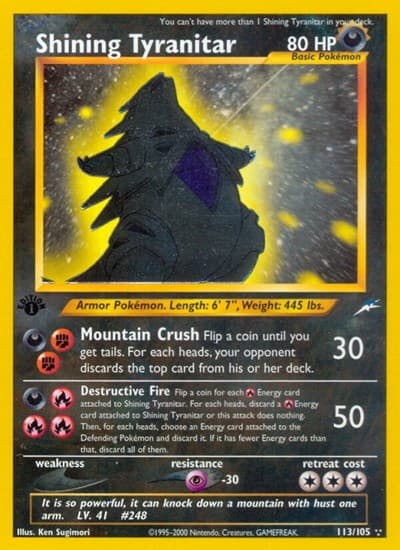
Ken Sugimori, best of 1,090
Shining Tyranitar (Neo Destiny, 2002), $4,250.
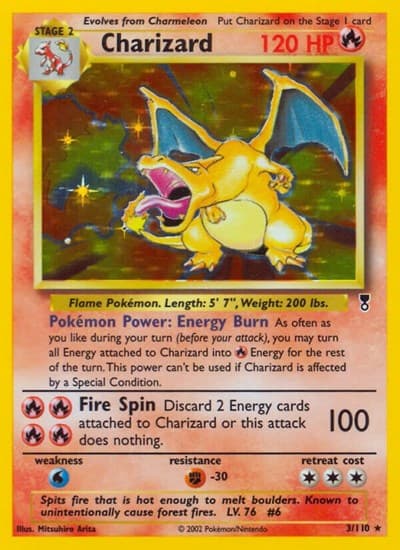
Mitsuhiro Arita, best of 720
Charizard (Legendary Collection, 2002), $1,950.
The pool of working artists has grown alongside the card count, from 21 credited in 1999 to 207 on cards released in 2026 alone. The 30th Celebration set leans into that growth with its headline gimmick of thirty Pikachu cards, each drawn by a different artist.
| Year | Credited illustrators |
|---|---|
| 1999 | 21 |
| 2000 | 23 |
| 2001 | 23 |
| 2002 | 47 |
| 2003 | 41 |
| 2004 | 42 |
| 2005 | 42 |
| 2006 | 43 |
| 2007 | 47 |
| 2008 | 37 |
| 2009 | 47 |
| 2010 | 40 |
| 2011 | 41 |
| 2012 | 46 |
| 2013 | 54 |
| 2014 | 40 |
| 2015 | 50 |
| 2016 | 84 |
| 2017 | 65 |
| 2018 | 79 |
| 2019 | 135 |
| 2020 | 88 |
| 2021 | 106 |
| 2022 | 120 |
| 2023 | 174 |
| 2024 | 183 |
| 2025 | 197 |
| 2026 | 207 |

06 — Master set completion cost
A new set can out-price a 27-year-old one
Every set guide on Cardrake shows the current completion cost for that specific set. Browse them from the expansions hub, or read the master set budgeting guide for strategies.
The comparison that surprised us most while building this page: completing the original Base Set, one copy of every card in its cheapest printing at today's market prices, runs about $2,265, while Ascended Heroes, a set released this January, costs roughly 3 times as much at about $6,627. Modern chase cards concentrate enormous value at the top of the rarity ladder while unlimited-print vintage commons stay cheap, so a brand-new set can out-price a 27-year-old one.
The chart shows the median set in each era, from real market prices only (no estimates; the methodology section has the exact rules). That is why its Base-era bar sits below Base Set itself: the median averages in cheaper siblings like Jungle and Fossil. Individual sets range widely around the medians. The most expensive single set to complete is Skyridge at about $35,967, reverse holos included, and that is with 1st Edition printings excluded.
| Era | Median completion cost |
|---|---|
| Base | $1,547 |
| Gym | $2,497 |
| Neo | $2,611 |
| E-Card | $23,511 |
| EX | $9,242 |
| Diamond & Pearl | $2,913 |
| Platinum | $4,012 |
| HeartGold & SoulSilver | $4,236 |
| Black & White | $2,362 |
| XY | $1,265 |
| Sun & Moon | $1,645 |
| Sword & Shield | $652 |
| Scarlet & Violet | $1,326 |
| Mega Evolution | $1,186 |

07 — Card value by era
The oldest cards are not the cheap ones
Set-level value rankings live in the most valuable sets guide, updated from live prices.
The median E-Card era card is worth $60.00 at market, against 48 cents for the median Scarlet & Violet card. The E-Card sets are Expedition, Aquapolis and Skyridge (2002 to 2003), the last Wizards of the Coast releases, named for the Nintendo e-Reader dot codes printed on their borders. They had short print runs and low pull rates at the bottom of the game's popularity trough, and twenty years later the whole era carries a premium. Modern sets flip the shape, printing enormous volumes where most cards are bulk and a handful of secret rares carry nearly all the value.
| Era | Median market price |
|---|---|
| Base | $5.95 |
| Gym | $8.14 |
| Neo | $11.54 |
| E-Card | $60.00 |
| EX | $28.08 |
| Diamond & Pearl | $6.37 |
| Platinum | $6.40 |
| HeartGold & SoulSilver | $11.57 |
| Black & White | $3.00 |
| XY | $1.36 |
| Sun & Moon | $1.24 |
| Sword & Shield | $0.52 |
| Scarlet & Violet | $0.48 |
| Mega Evolution | $0.31 |

08 — Right now
The most chased cards right now
This one comes from our own data rather than the catalog. Cardrake scores every card nightly on price level, price momentum, and collector demand (the Chase Score). As of 2026-08-13, the top of the ladder is a Prismatic Evolutions story: the Eeveelution Special Illustration Rares hold most of the top ten, with Umbreon ex at $1,513 the most expensive of them.
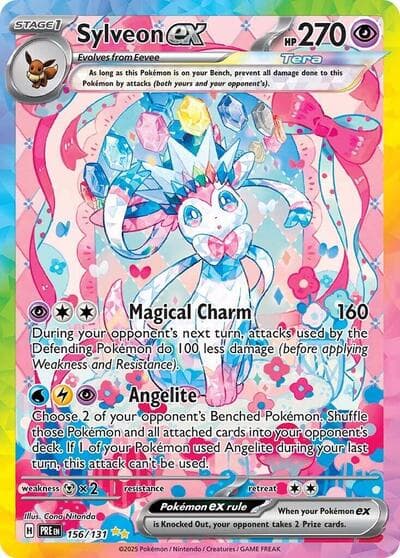
Sylveon ex
$546
Prismatic Evolutions · Chase 93
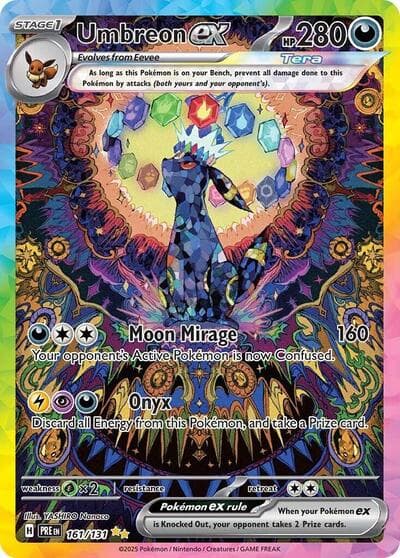
Umbreon ex
$1,513
Prismatic Evolutions · Chase 92
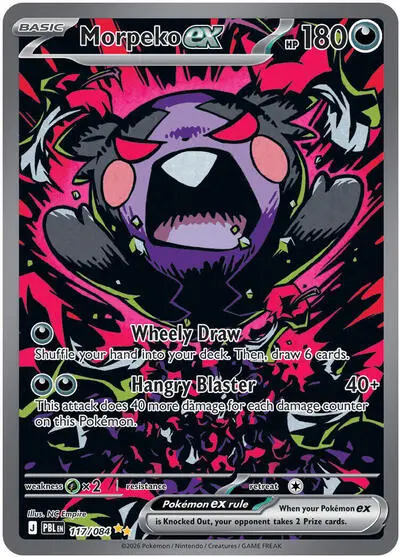
Morpeko ex
$124
Pitch Black · Chase 92
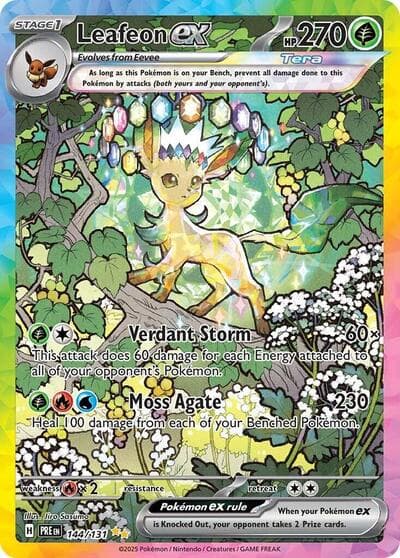
Leafeon ex
$340
Prismatic Evolutions · Chase 90
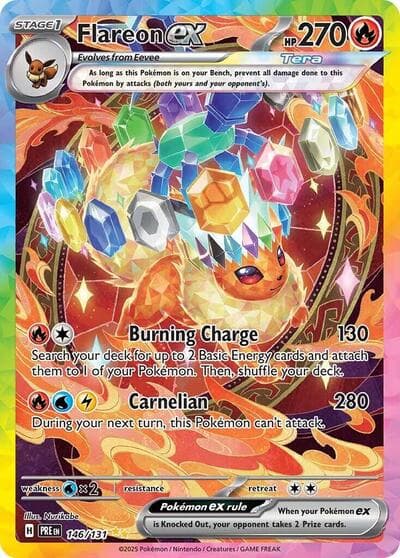
Flareon ex
$228
Prismatic Evolutions · Chase 90
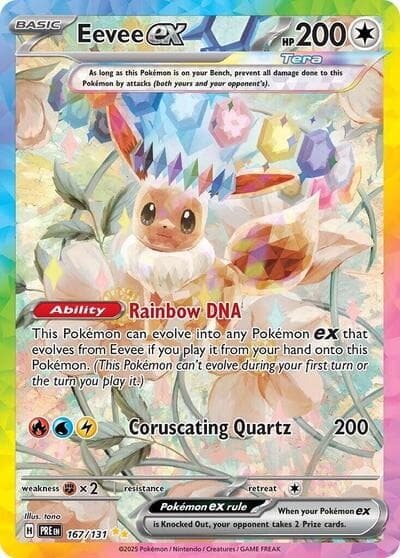
Eevee ex
$191
Prismatic Evolutions · Chase 90

Mega Zeraora ex
$73
Pitch Black · Chase 90
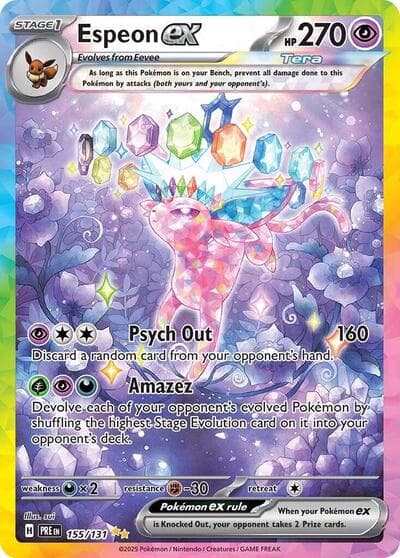
Espeon ex
$309
Prismatic Evolutions · Chase 88
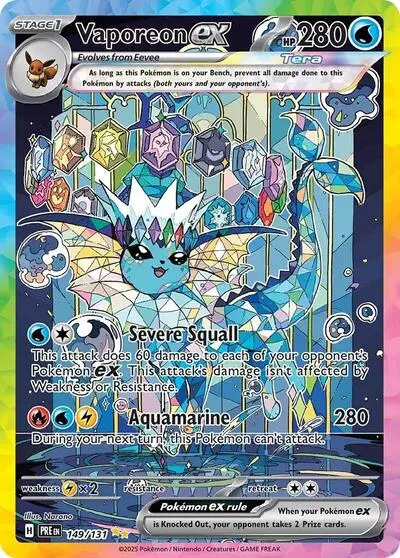
Vaporeon ex
$302
Prismatic Evolutions · Chase 88
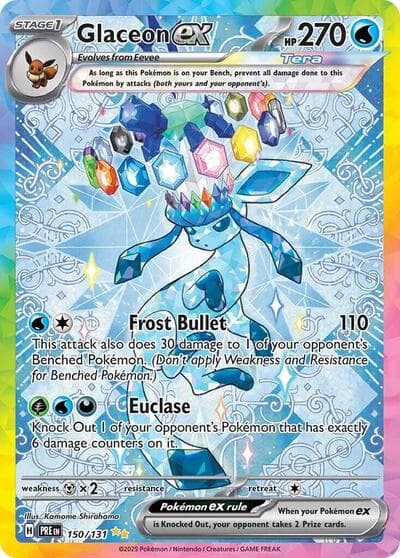
Glaceon ex
$289
Prismatic Evolutions · Chase 88
| Card | Set | Chase Score | Market |
|---|---|---|---|
| Sylveon ex | Prismatic Evolutions | 93 | $546 |
| Umbreon ex | Prismatic Evolutions | 92 | $1,513 |
| Morpeko ex | Pitch Black | 92 | $124 |
| Leafeon ex | Prismatic Evolutions | 90 | $340 |
| Flareon ex | Prismatic Evolutions | 90 | $228 |
| Eevee ex | Prismatic Evolutions | 90 | $191 |
| Mega Zeraora ex | Pitch Black | 90 | $73 |
| Espeon ex | Prismatic Evolutions | 88 | $309 |
| Vaporeon ex | Prismatic Evolutions | 88 | $302 |
| Glaceon ex | Prismatic Evolutions | 88 | $289 |
09 — If you owned every card
Closer to furniture than to a shoebox
A complete English collection, one copy of each card, would stack 6.25 meters tall and weigh about 35.5 kilograms unsleeved, and storing it properly takes 57 binders of 360 pockets each. The math behind those figures is plain multiplication (0.305 mm and 1.73 g per card), and it lands somewhere closer to furniture than to a shoebox under the bed.
6.25m
Stack height
35.5kg
Weight, unsleeved
57
360-pocket binders
Methodology
How these numbers were made
Sets not yet in the catalog and excluded from every number above: 30th Celebration, EX Trainer Kit 2 Minun, EX Trainer Kit Latias, EX Trainer Kit Latios, McDonald's Collection 2011, McDonald's Collection 2012, McDonald's Collection 2014, McDonald's Collection 2015, McDonald's Collection 2016, McDonald's Collection 2017, McDonald's Collection 2018, McDonald's Collection 2019, McDonald's Collection 2021, McDonald's Collection 2022, Pokémon Futsal Collection. Card metadata is cross-referenced against the community-maintained pokemontcg.io dataset; prices are TCGplayer market data. Artist credits cover 92 percent of cards, so treat the illustrator counts as minimums rather than exact figures.
How many Pokémon cards are there, exactly?
There are 20,493 unique English-language Pokémon cards as of 2026-07-20, released across 163 sets. That figure counts every card in our catalog including secret rares and promo cards, but not Japanese-exclusive releases. Counting only the 143 mainline expansion sets, the number is 18,966.
What counts as one card in this count?
One catalog entry per set number. A card and its reverse holo are one card; a base-set print and its secret-rare alternate art are two, because they carry different set numbers. Sets we have not catalogued yet (mostly McDonald's mini-collections and the upcoming 30th Celebration) are excluded and listed in the methodology.
Where do the prices come from?
Current TCGplayer market prices. Completion costs are computed directly from those prices: one copy of every card in its cheapest printing (unlimited rather than 1st Edition for vintage sets), plus the reverse holo where one exists. A handful of vintage cards have no current market value because they rarely trade; those use their TCGplayer mid price instead (Base Set Charizard is one of them). No estimation is involved; a set is excluded from the cost charts unless at least 90 percent of its cards have a price.
Can I use these charts and numbers?
Yes. Every chart has a CSV download and an embeddable version, and you are welcome to quote any number on this page. We ask for a link to this page as the source. See the "Use this data" section for a ready-made attribution line.
Use this data
Quote any number, download any chart's CSV, or embed the live charts with the button under each one. We ask for one thing in return: link to this page as the source. Journalists and creators, if you need a cut of the data that is not here (a specific era, set, or artist), we are happy to run it. Every underlying number comes from the same database that powers the set guides and binder planner.
Source: Cardrake, “30 Years of Pokémon TCG in Data” (cardrake.com/guides/30-years-of-pokemon-tcg)