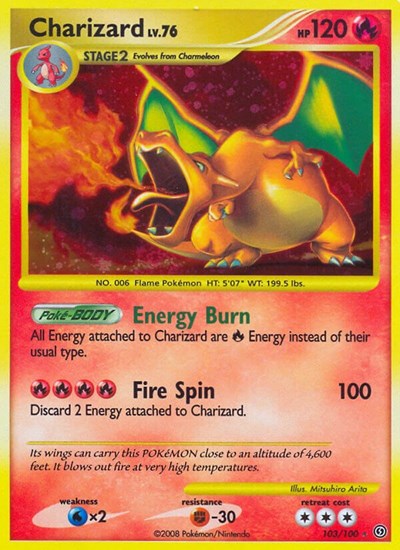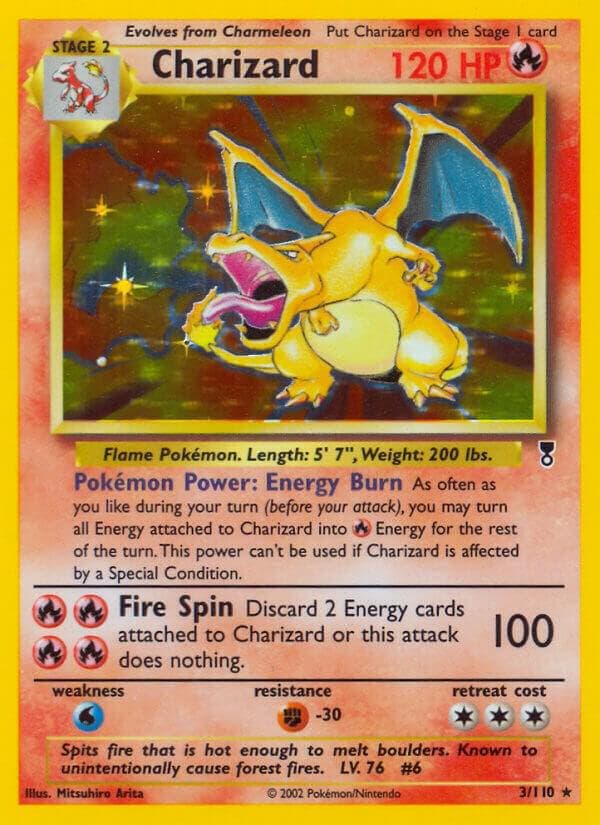
Charizard
Quick take
- From Legendary Collection (2002), the last WotC-produced English set
- Reuses Mitsuhiro Arita's original Base Set Charizard artwork
- Exists as a regular holo and as the scarcer fireworks reverse holo
- Vintage anchor card for a master set, with the reverse holo as the chase
Collector's readWhat it means for your master set
Set landscapeWhere this card sits in Legendary Collection
VariantsCard variants
Variants are the different finishes of the same card — the standard print, reverse holo, and any special patterns. A complete master set needs every variant below, so track each one in your collection.
| Variant | Note | Market |
|---|---|---|
| Reverse Holo 3/110 | Reverse-holo variant. | $1399.31 |
| Holofoil 3/110 | Holofoil variant. | $899.99 |
The storyThe Base Set classic, carried into the last WotC English set
Legendary Collection landed in May 2002 as the final WotC-produced English expansion before the franchise moved to Nintendo. The set reprinted favorites from Base Set, Jungle, Fossil, and Team Rocket using the original card frames. Charizard sits at number 3, and the art is the same Mitsuhiro Arita scene collectors know from Base Set.
“From Legendary Collection (2002), the last WotC-produced English set”
What makes this printing matter is the set it came from. Legendary Collection introduced the reverse holofoil, the fireworks pattern that shimmers across everything but the art window. Charizard exists here in a regular holo and in that reverse holo treatment. The reverse is the version that turns heads, and it is one of the standout chase cards of a set that was already printed lighter than the Base Set era.
For a master-set build, the holo is the spine of the run and the reverse holo is the trophy. Both carry the weight of the most iconic Pokemon card design ever made, which keeps demand steady regardless of what the rest of the market is doing.
By the numbersMarket analysis
This is a vintage Charizard, so it lives well up the value ladder. The regular holo is a solid three-figure card in raw mid-grade and climbs from there with condition. The fireworks reverse holo is the real money piece, trading meaningfully higher than the regular holo and pushing into strong four-figure territory in top grades.
Vintage Charizard demand has been durable for years. Prices firmed up through the late-pandemic vintage boom and have held better than most reprint-era cards since, because the Arita art and the Charizard name do the heavy lifting.
Vintage Charizard is about as blue-chip as Pokemon gets, but you pay for it. The regular holo is the accessible entry. The reverse holo has the thinner supply and the bigger upside, and also the bigger downside if you overpay on a raw copy. Buy condition you can verify.
Grading premiums are steep here. Clean PSA 9 copies command a strong multiple over raw, and PSA 10s sit far above that, especially for the reverse holo where Gem Mint examples are scarce. Centering and surface on these fireworks cards are notoriously hard, so high grades are genuinely rare.
Legendary Collection predates modern rarity slotting, so there are no clean published per-pack odds the way Scarlet & Violet sets carry. What collectors know is supply. Legendary Collection was printed lighter than the Base Set era, the set is more than twenty years old, and the fireworks reverse holo of Charizard sits among the hardest pulls in the set. The regular holo is more available than the reverse, but neither is common in clean condition. Treat this as a buy-the-single card rather than something you reasonably pull yourself today.
Against the original Base Set holo, the Legendary Collection regular holo usually trades softer, which makes it a more affordable way to own the Arita art. The reverse holo flips that. It often commands a premium over the regular holo because the graded population is so much thinner.
ArtworkWhy the art matters

Mitsuhiro Arita is the illustrator behind the original Base Set Charizard, the most famous single piece of art in the entire Pokemon TCG. He has drawn hundreds of cards across the game's history and remains one of the most requested artists at signing events. His Charizard is the image most people picture when they think of a Pokemon card.
Charizard mid-roar, wings spread, flame tail curling up behind it, set against a soft sky-and-cloud background. It is the exact Base Set composition collectors grew up with, carried over intact into the Legendary Collection frame.
The card uses the classic WotC holo treatment in the art window for the regular version. The reverse holo flips that idea on its head. The fireworks foil pattern runs across the card body while the artwork stays matte, which is what gives the reverse its distinctive sparkle.
You get the single most iconic Pokemon artwork in two finishes, including the fireworks reverse that only Legendary Collection produced. For collectors who love the Base Set look but want something less endlessly reprinted than the original, this is the sweet spot.
BackgroundAbout Charizard
Charizard has been the face of the Pokemon TCG since the Base Set holo in 1999. It is the card that built the secondary market and the one new collectors chase first. Any vintage Charizard printing carries that history, and the Arita art version is the canonical one.
- ›The original mascot-tier chase card of the hobby
- ›Arita's Base Set composition is universally recognized
- ›Fire-type, fully evolved, the classic playground status symbol
- ›Vintage WotC pedigree that newer Charizards cannot replicate
- ›Base Set holo (1999), the card that started it all
- ›Base Set 2 reprint (2000)
- ›Legendary Collection (2002), this card, with the added fireworks reverse holo
Own it wellCollector guide
Two big problems on these. Centering is frequently off, and the holo and reverse-holo surfaces show print lines and scratches easily under good light. The reverse holo in particular tends to grade harshly, because the fireworks foil reveals every surface flaw.
For any serious purchase, buy graded from PSA, BGS, or CGC. The regular holo is worth grading if your raw copy is genuinely clean and well centered. The reverse holo is almost always worth submitting if it is high-end, given how much Gem Mint examples carry. Read the grading guide →
Penny sleeve plus a top-loader or one-touch at minimum, and a card saver if you plan to submit for grading. Keep it out of direct light and away from humidity. For a card at this value, a graded slab is the safest long-term home. See the storage guide →
Decide up front whether you want the regular holo or the fireworks reverse, because they sit in very different price tiers. Vintage Charizard is one of the most counterfeited cards in the hobby. For raw copies inspect carefully, and for anything at real money buy graded from a reputable seller. Confirm you are looking at the Legendary Collection number 3, not a Base Set holo, since the art is identical. See the singles buying guide →
Standard vintage Charizard checks apply. Do the light test to confirm the black core layer inside the cardstock. A real WotC card shows that dark center line at the edge. Feel the surface, since the holo and reverse-holo texture should match a known genuine copy. Watch the holo behavior in the light, because fakes often look flat or wrong-colored. Check the back swirl, where the blue gradient should be smooth and correctly colored, not muddy or off-hue. Compare the number 3 and the Legendary Collection layout against a reference image. When in doubt, buy it already slabbed.
Protect your card
High Chase Score — protect and consider grading. · Amazon affiliate links · Storage guideWord on the streetCommunity sentiment
Legendary Collection is one of the best-loved reprint sets in the hobby, mostly because of the fireworks reverse holos. Charizard is the headliner of that group, and collectors talk about it as a must-have for anyone building the set.
- ›High-grade fireworks reverse holo examples are widely reported trading well into four figures in PSA 10
- ›Regular holo copies trade as a strong three-figure card in clean condition
The fireworks reverse holo regularly shows up in vintage collection showcases and gets called out as a grail-tier pull from the set. The regular holo gets recommended often as a cheaper way to own the Base Set Arita art without Base Set pricing.
Good to knowFrequently asked questions
Keep collectingRelated cards


Plan your Other Legendary Collection master set
Track every card, see what you're missing, and lay out your binder page by page.