Alakazam Star
Quick take
- Vintage 2006 Gold Star, card 99/100 in EX Crystal Guardians
- Shows Alakazam in shiny, alternate-color form
- Illustrated by Masakazu Fukuda, the defining Gold Star artist
- One of the top set-completion hurdles for an EX Crystal Guardians master set
Collector's readWhat it means for your master set
Set landscapeWhere this card sits in EX Crystal Guardians
VariantsCard variants
Holofoil 99/100 · $1429.50 — the only variant this card was printed in (no reverse holo or special pattern), so a master set needs just this one copy.
The storyA Kanto legend in Gold Star dress
Alakazam Star sits in the small club of mid-2000s Gold Stars, the chase tier that defined the EX era. Each Gold Star showed a Pokemon in its shiny, alternate-color form, marked by a tiny gold star next to the name. Alakazam was a natural pick. It has been a fan favorite since Red and Blue, and putting it in shiny form on a card pulled at roughly one per two booster boxes made it an instant target.
“Vintage 2006 Gold Star, card 99/100 in EX Crystal Guardians”
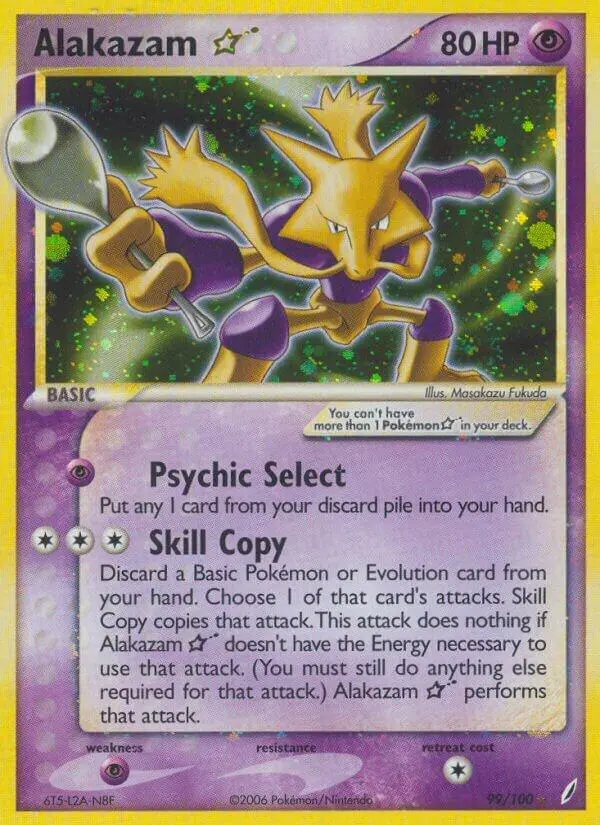
The card came out in 2006 as part of EX Crystal Guardians, card 99 of 100. In Japan it landed first in Miracle Crystal as 033/075. Mechanically it is a Basic Psychic Pokemon with 80 HP, a Psychic Select attack, and a Skill Copy attack that borrows a move from a Basic or Evolution card in hand. The competitive side was never the point. The Gold Star treatment is what put it on collector want lists, and it has stayed there.
For master set builders, this is one of the cards that makes EX Crystal Guardians hard to finish. You can chip away at the commons and rares for a long time before a clean Alakazam Star shows up at a price you like.
By the numbersMarket analysis
Alakazam Star plays in the four-to-five-figure vintage Gold Star range once you get into high grades. Raw copies in rough shape are far more reachable, but condition and grade swing the value hard. It is one of the top cards in the set by value.
Graded PSA 10 sales have been choppy rather than a clean line up. Prices firmed into early 2025 after a softer mid-2024 stretch, which tracks the broader vintage Gold Star market: thin supply, lumpy demand, and big gaps between individual sales.
This is a blue-chip vintage chase with a known, capped supply. The upside is real but the market is illiquid, so expect wide bid-ask gaps and slow sales. Grade matters more here than almost any other factor. Treat it as a long-hold collector piece, not a quick flip.
The premium for a clean high grade is steep. A PSA 10 trades at a large multiple over raw and over lower-grade copies, because gem-mint vintage Gold Stars are scarce and centering plus surface issues knock most copies down. A strong centered copy with a clean back swirl is worth chasing in grade.
Gold Stars from this era were brutal pulls. Across most EX sets you were looking at roughly one Gold Star per two booster boxes, on the order of one in seventy-two packs, and that figure is for any Gold Star in the set, not this specific card. EX Crystal Guardians had a handful of Gold Stars sharing that slot, so the odds of pulling Alakazam in particular ran far longer. The one EX set that loosened up was EX Power Keepers, which ran closer to one or two Gold Stars per box. Bottom line: nobody completes a Gold Star master set on pack luck alone. These get bought as singles.
Compared to a modern Special Illustration Rare at roughly one in ninety packs, a vintage Gold Star is rarer per pull and far rarer in clean condition, since twenty-year-old cardboard rarely survives gem-mint. The fixed vintage population is the real difference. No reprints, no chase variant refresh.
ArtworkWhy the art matters

Fukuda is the illustrator most associated with the Gold Star run. He drew the bulk of the Gold Star cards across the EX era, so his style basically defines how these shinies look on cardboard. Collectors who chase Gold Stars are, in large part, chasing his catalog.
The card shows Alakazam in its shiny coloring rather than its standard brown. The gold star sits right next to the name, the signal that this is the alternate-color chase version. The holo treatment runs across the art area in the EX-era Gold Star style.
Standard EX-era Gold Star layout: holofoil in the illustration window, the gold star icon by the name, and the card number 99/100 marking it in the secret-rare slot at the back of the set. The Japanese print appeared in Miracle Crystal as 033/075.
It pairs a top-tier nostalgic Pokemon with the Gold Star format. You get a Gen 1 icon, shiny art, a finite vintage population, and Fukuda's name all on one card.
BackgroundAbout Alakazam Star
Alakazam debuted in Red and Blue as the final evolution of Abra and Kadabra, evolving only by trade. It has been a poster child for psychic-type power since 1996, famous for its sky-high Special stat. That long-running recognition is a big part of why collectors care about this card.
- ›Original 151 Pokemon with constant nostalgia pull
- ›One of the iconic psychic-types from Gen 1
- ›Trade-only evolution gave it a memorable, slightly mythical reputation
- ›Strong appeal as a shiny on the Gold Star format
- ›Final evolution of the Abra line in Red, Blue, and Yellow
- ›Recurring psychic-type presence across the anime and later games
Own it wellCollector guide
Twenty-year-old holos show their age. Look hard at centering, edge whitening, surface scratches in the holo, and print lines. Many raw copies grade lower than they look in a listing photo, so judge centering front and back before you commit.
For any serious money, buy it already graded by PSA, CGC, or BGS. If you own a raw copy in strong shape, grading is usually worth it given how large the gem-mint premium is. Centering is the most common ceiling on the grade for this card. Read the grading guide →
Sleeve in a penny sleeve plus a snug top loader or a card saver, and keep it out of direct light and humidity. For a raw copy you plan to grade, avoid anything that scuffs the holo surface. For graded slabs, store upright and away from heat. See the storage guide →
This is one of the most counterfeited vintage cards, so authenticate before you pay. Light test it. Real Gold Stars have a black core layer that blocks light, while many fakes glow through. Check the surface texture, watch how the holo behaves when you tilt it, and inspect the back swirl gradient against a known-genuine card. For anything beyond pocket change, buy graded from a reputable source and you sidestep most of the risk. See the singles buying guide →
Hold it to a bright light. Genuine cards have an opaque black inner layer, fakes often let light pass. Feel for the correct linen surface texture, confirm the holo pattern matches period Gold Stars, and compare the back's blue swirl gradient to an authenticated card. When in doubt, trust a slab over a raw listing.
Protect your card
High Chase Score — protect and consider grading. · Amazon affiliate links · Storage guideWord on the streetCommunity sentiment
Collectors treat Alakazam Star as a respected vintage Gold Star rather than a top-three headline grail. Alakazam carries real Gen 1 affection, and the consensus is that demand stays steady even when prices drift, because the supply is fixed and the name is iconic.
- ›Graded PSA 10 Gem Mint copies have changed hands publicly through major auction and marketplace channels, with results firming into early 2025 after a softer 2024.
Most chatter centers on grading and authentication: spotting fakes, debating centering, and comparing PSA 10 versus lower grades. It surfaces in Gold Star ranking lists and EX Crystal Guardians set-completion threads more than in hype cycles.
Good to knowFrequently asked questions
Keep collectingRelated cards


Plan your Other EX Crystal Guardians master set
Track every card, see what you're missing, and lay out your binder page by page.