Latias Star
Quick take
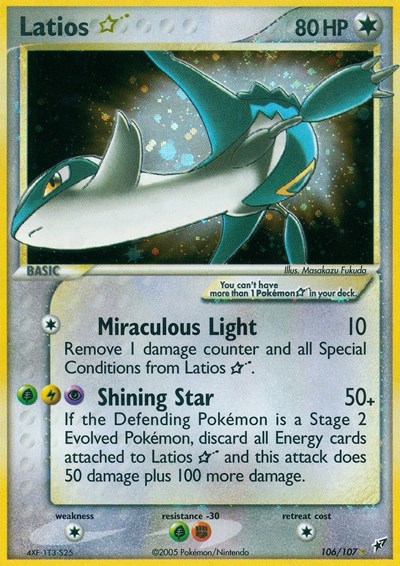
- One of the two Eon duo Gold Stars in EX Deoxys, alongside Latios
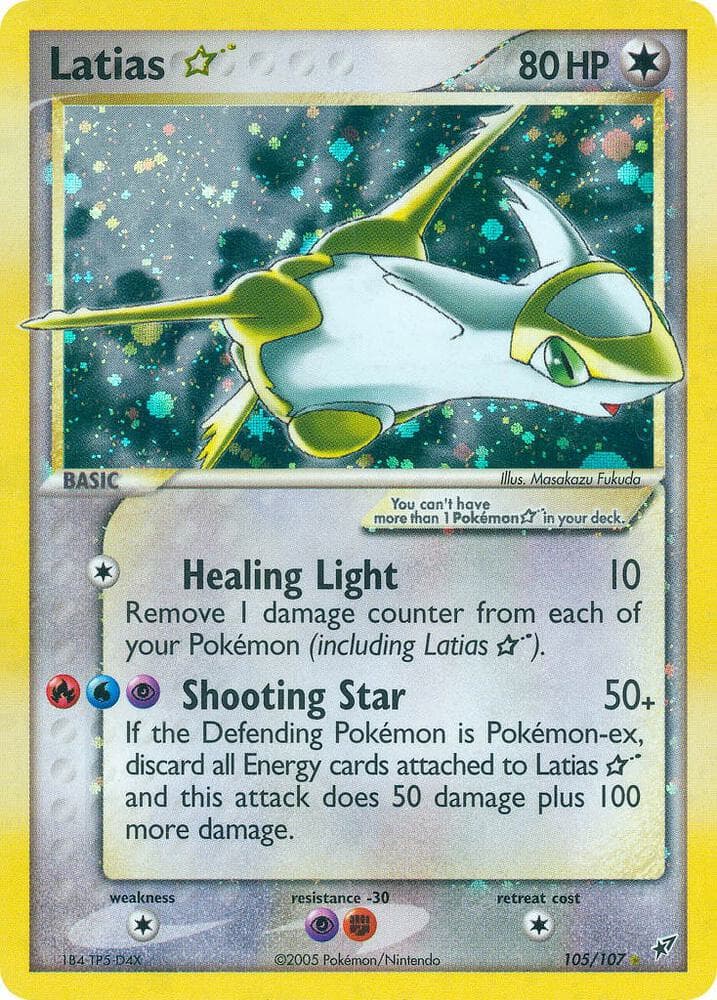
- Shiny Latias with the gold star and frame-breaking art
- From 2005, early in the Gold Star era
- A centerpiece for legendary and Eon duo collectors
Collector's readWhat it means for your master set
Set landscapeWhere this card sits in EX Deoxys
VariantsCard variants
Holofoil 105/107 · $1700.00 — the only variant this card was printed in (no reverse holo or special pattern), so a master set needs just this one copy.
The storyHalf of the Eon duo's Gold Star pair
Latias and Latios travel together. They were the legendary pair of Generation III, the stars of the fifth Pokemon movie, and in EX Deoxys they each got a Gold Star. Collectors usually want both, which keeps demand on the Latias healthy even though Latios tends to draw slightly more attention.
“One of the two Eon duo Gold Stars in EX Deoxys, alongside Latios”
EX Deoxys came out in 2005, early in the Gold Star era. The card shows a shiny Latias breaking past its frame in the alternate coloring the Gold Stars used. As a retail Gold Star it pulled at the standard rate of about one per two booster boxes.
Legendary Pokemon hold their own collecting niche, and the Eon duo sits near the top of it. The Gold Star is the vintage centerpiece for anyone building a Latias or Lati-pair collection.
By the numbersMarket analysis
A solid upper-tier EX-era Gold Star. Raw copies trade in the four figures, with clean graded examples higher. It sits a notch below the Charizard and Pikachu Gold Stars on demand, but legendary appeal keeps it firmly in chase territory.
Appreciated through the vintage boom and held most of those gains. The supply is fixed at the 2005 print run, and demand follows interest in the Eon duo and legendary Pokemon, which has been durable.
Reliable rather than explosive. Fixed supply and steady legendary demand support the price, and the matched-pair dynamic gives it a built-in audience. Condition is the main constraint, and graded copies hold the safer position.
Meaningful. Clean high grades trade well above raw and gem-mint copies are scarce for a 2005 textured holo. Centering and surface wear are the usual reasons a copy misses the top grade.
EX-era Gold Stars pulled at roughly 1 per two booster boxes, around 1 in 72 packs, and EX Deoxys followed that pattern. With both Latias and Latios in the set as Gold Stars, landing a specific one was a long shot.
Standard EX Gold Star pull rate, more available than the league-only POP 5 Eeveelutions. Within the Gold Star run it trades below the Charizard and Pikachu, which carry broader mainstream demand, but ahead of many of the lesser-known Pokemon in the class.
ArtworkWhy the art matters

Fukuda illustrated the bulk of the Gold Star run, including the matching Latios. His Gold Star cards share a clean, single-subject look that lets the shiny coloring and foil carry the design.
A shiny Latias in flight, drawn in the alternate Gold Star coloring and breaking past its inner frame. The pose leans into the Pokemon's graceful, airborne design.
Rare Holo Gold Star printing with the gold star beside the name and the textured holofoil of the era. The shiny palette distinguishes it from the standard Latias cards.
It pairs with the Latios Gold Star to complete the Eon duo in their rarest vintage form. For legendary collectors, that pairing is the draw.
BackgroundAbout Latias Star
Latias debuted in Ruby and Sapphire in 2002 as one of the Eon duo, the Dragon and Psychic legendary pair alongside Latios. The two are tied together in the games, the anime, and collector culture, and Latias headlined the fifth Pokemon movie.
- ›Strong legendary Pokemon following
- ›The Eon duo bond that drives paired collecting
- ›A starring role in Pokemon Heroes (the fifth movie)
- ›An elegant design that has aged well
- ›Debuted in Pokemon Ruby and Sapphire (2002)
- ›Starred in Pokemon Heroes: Latios and Latias (2002 film)
- ›Recurring legendary in later games and events
The EX Deoxys card is collected for display. Its value comes from the Eon duo's popularity and the Gold Star rarity, not from play.
Own it wellCollector guide
A 2005 textured holo, so surface scratching is the main worry, with the usual edge whitening and centering drift on top. Clean copies are scarce and priced accordingly.
Grade clean copies. The high-grade premium is worth it and a slab handles authentication. PSA is the standard for vintage Pokemon and has the deepest comp data for this card, with CGC and BGS as alternatives. Read the grading guide →
Sleeve and a rigid holder for raw copies, a graded slab for long holds. Keep it out of light and stable on humidity to protect the textured surface. See the storage guide →
Graded is the safer buy at this value. eBay carries the deepest graded supply, and sold comps beat asking prices as a guide. If you want the full Eon duo, budget for two scarce cards, not one. See the singles buying guide →
Gold Stars are common counterfeit targets. Use the light test (genuine cards block light through a black core layer), check the textured holo and print sharpness, and compare the back's blue swirl gradient to a known card. For serious money, buy a graded slab from PSA, CGC, or BGS.
Protect your card
High Chase Score — protect and consider grading. · Amazon affiliate links · Storage guideWord on the streetCommunity sentiment
Well regarded among legendary and Eon duo collectors. It rarely tops 'most wanted Gold Star' lists, but it has a steady, devoted audience that keeps demand consistent.
- ›Clean graded copies trade in the four-to-five-figure range
- ›Dozens of recorded graded sales over the years, showing a liquid market for the card
Comes up in Eon duo and legendary collection content, usually paired with the Latios Gold Star. It is a frequent goal for collectors who focus on Generation III legendaries.
Good to knowFrequently asked questions
Keep collectingRelated cards


Plan your Other EX Deoxys master set
Track every card, see what you're missing, and lay out your binder page by page.