Charizard
Quick take
- First Secret Rare ever printed in an English Pokemon set
- Numbered 103/100, sitting past the set's stated 100-card count
- Brings back Energy Burn and Fire Spin from the 1999 Base Set Charizard
- The chase card that anchors the price of a complete Stormfront master set
Collector's readWhat it means for your master set
Set landscapeWhere this card sits in Stormfront
VariantsCard variants
Holofoil 103/100 · $737.50 — the only variant this card was printed in (no reverse holo or special pattern), so a master set needs just this one copy.
The storyThe card that started the Secret Rare era
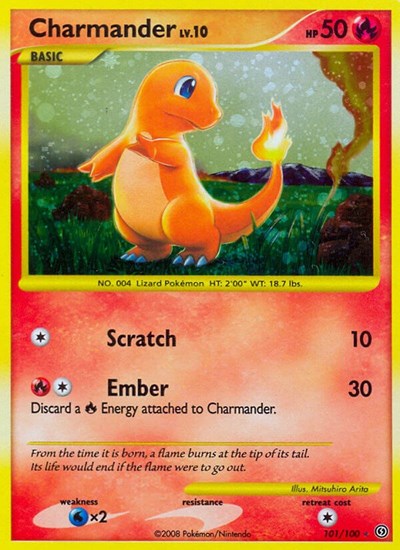
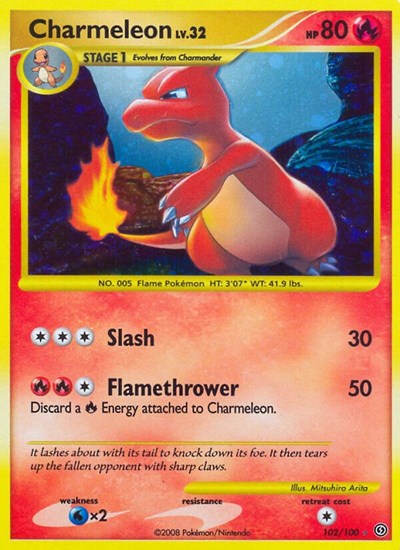
Stormfront, released in late 2008, was the set that introduced the Secret Rare concept to the English Pokemon TCG. The numbering tells the story. The set was advertised as 100 cards, and 103/100 sits past the official count, hidden beyond where a checklist says the set ends. Three cards got that treatment in Stormfront, the Charmander line of Charmander 101/100, Charmeleon 102/100, and Charizard 103/100. Pokemon gave the headline slot to Charizard.
“First Secret Rare ever printed in an English Pokemon set”
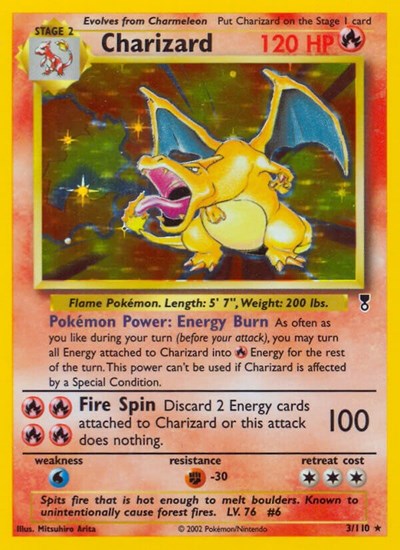
That choice was not an accident. By 2008 Charizard already carried the weight of Base Set nostalgia, and this card leaned into it. The Poke-Body is Energy Burn. The attack is Fire Spin. Those are the exact mechanics from the 1999 Base Set Charizard, ported forward almost a decade later. Anyone who grew up chasing the original recognized the callback immediately.
For a master-set collector, the significance is structural. You cannot complete a Stormfront master set without it, and because it is the chase card of the whole release, the set effectively gets priced around this one slot. Finish everything else and you still have the hardest pull waiting.
By the numbersMarket analysis
This is the top card of the Stormfront set by a wide margin, sitting in vintage three-figure territory raw and climbing higher in strong grades. It anchors the price of any complete Stormfront master set.
Like most well-known vintage Charizards, it has trended up over the long run as the Diamond and Pearl era moved into nostalgia territory. Demand is steady rather than spiky, and graded copies carry most of the momentum.
The combination of Charizard, vintage, and a first-of-its-kind milestone keeps this on most collectors' radar. Raw copies in rough shape are common and trade low, so the value really lives in clean, high-grade examples. Condition is doing the heavy lifting here.
The premium for a clean graded copy over a raw played one is significant. Vintage holos take edge wear and surface scratches easily, so gem-grade examples pull well clear of the raw market. Most serious money in this card changes hands graded.
Stormfront predates the published-odds era, so there is no official Pokemon pull-rate sheet for it the way there is for modern sets. Secret Rares from this period were short-printed and pulled at a fraction of the rate of standard holos, which is why clean copies are scarce relative to demand. For a sense of scale, today's Scarlet and Violet sets run roughly one Double Rare per five packs, one Illustration Rare per twelve, one Ultra Rare per fifteen, one Special Illustration Rare per ninety, and one Hyper Rare somewhere in the range of one in 300 to 700 packs. Those odds describe any card of that rarity, not one specific card, so a single named chase usually runs much longer, often into the hundreds of packs for a specific SIR. Vintage Secret Rares like this Charizard sat at the steep end of that spectrum, hard to hit fresh and harder to find undamaged years later.
Worth knowing this is not a Gold Star. Gold Stars were a separate EX-era mechanic from 2004 to 2007, marked by a gold star next to the Pokemon's name and shiny alternate-color art, illustrated by Masakazu Fukuda and pulled at roughly one per two booster boxes, around one in 72 packs. Stormfront's Charizard is a Diamond and Pearl era Secret Rare, a different and newer tier. Both are vintage chase Charizards, but they are not the same kind of card.
ArtworkWhy the art matters

Mitsuhiro Arita is the illustrator behind the original 1999 Base Set Charizard, the most famous Pokemon card ever printed. His name is tied to Charizard art more than any other artist's, which makes his return to the character on the first English Secret Rare feel deliberate. He has signed and sketched copies of this card at events, and those signed examples carry their own collector following.
The illustration shows Charizard in flight, wings spread, breathing fire. It is a dynamic action pose rather than a static portrait, matching the Fire Spin attack and the flavor of the Pokemon soaring at altitude and blowing flame at extreme temperatures.
Standard Diamond and Pearl era holofoil with the LV.X-era card frame. The card is Charizard LV.76, a Stage 2 evolving from Charmeleon. The holo sits across the artwork window in the flat foil pattern of the period, not the cosmos or textured foils that came later. The number reads 103/100, the tell that marks it as a Secret Rare sitting past the set's stated size.
Arita drawing Charizard for the debut of a new rarity tier closes a loop. The most famous Pokemon artist returned to the most famous Pokemon for a card designed to be the hardest pull in the set. The art and the mechanics both point back to Base Set on purpose.
BackgroundAbout Charizard
Charizard is the final evolution of Charmander, one of the three Kanto starters, and has been the face of the franchise since the original games. In the TCG it carries more collector weight than any other Pokemon. A Charizard card almost always becomes the most wanted card in whatever set it appears in, and Stormfront is a textbook case.
- ›The most recognizable and sought-after Pokemon in the entire hobby
- ›Years of Base Set nostalgia attached to the character
- ›Fan-favorite design that has stayed consistent across generations
- ›Heavy presence in anime, games, and merchandise keeping it front of mind
- ›1999 Base Set Charizard, also illustrated by Mitsuhiro Arita, the most iconic card in the hobby
- ›Chase-card slots across modern sets where Charizard reliably tops the price list
Built as a nostalgia and collector piece rather than a tournament staple. The Energy Burn and Fire Spin setup is a tribute to Base Set, and by 2008 standards the card was a slow Stage 2 attacker, not a competitive answer. Its value has always been about the name and the milestone, not the play.
Own it wellCollector guide
Vintage holos from this era show their age. Watch for edge whitening, surface scratches across the foil, and print lines. The black border makes any edge wear obvious, which is part of why high grades command such a premium. Inspect the holo under angled light before buying.
Worth grading for clean copies, and strongly recommended if you are buying at any serious price. A graded slab both protects the card and confirms authenticity, which matters a lot for a heavily counterfeited Charizard. For a master set, a graded 103 makes a fitting centerpiece. Read the grading guide →
Penny sleeve plus a toploader or one-touch at minimum for a raw copy, kept out of direct light and away from humidity. For anything in nice shape, graded storage is the safer long-term call. Vintage foil does not recover once it scratches. See the storage guide →
Charizard is one of the most counterfeited cards in the hobby, and this one is no exception. For real money, buy graded from a reputable seller. If you are buying raw, use the standard vintage authentication checks. Run the light test to confirm the black core layer inside the cardstock. Check that the surface texture feels like period stock rather than a glossy reprint. Confirm the holo behaves like period foil, and look for a clean back-swirl gradient. If any of those fail, walk. Signed and sketched Arita copies exist and carry a premium, but signatures add another authentication layer, so verify the signing event or COA. See the singles buying guide →
Run the light test to check for the dark inner layer real cards have. Feel the surface texture, watch how the holo catches light, and inspect the back swirl gradient against a known-genuine card. Counterfeits often miss on the back swirl and the cardstock layering. When the price gets serious, let a grading company do the authentication for you.
Protect your card
High Chase Score — protect and consider grading. · Amazon affiliate links · Storage guideWord on the streetCommunity sentiment
Long regarded as one of the standout Charizards of the Diamond and Pearl era and a genuine collector favorite. Its status as the first English Secret Rare gives it a place in TCG history that goes beyond the usual Charizard hype, and collectors tend to treat it as a milestone piece.
Comes up regularly in discussions of vintage Charizards and best-of-DP-era cards. The Base Set callback and the first-Secret-Rare angle are the points collectors raise most often. Signed Arita copies and high-grade examples draw extra attention when they surface.
Good to knowFrequently asked questions
Keep collectingRelated cards


Plan your Other Stormfront master set
Track every card, see what you're missing, and lay out your binder page by page.