Dark Blastoise
Quick take
- First Pokemon set to introduce reverse holofoil cards, the set's signature feature
- Mitsuhiro Arita art, the same illustrator behind the Base Set Charizard
- Exists as standard Rare Holo, reverse holo, and oversized box-topper jumbo
- A Team Rocket Dark Pokemon reprint with a built-in collector following
Collector's readWhat it means for your master set
Set landscapeWhere this card sits in Legendary Collection
VariantsCard variants
Variants are the different finishes of the same card — the standard print, reverse holo, and any special patterns. A complete master set needs every variant below, so track each one in your collection.
| Variant | Note | Market |
|---|---|---|
| Reverse Holo 4/110 | Reverse-holo variant. | $975.00 |
| Holofoil 4/110 | Holofoil variant. | $234.65 |
The storyThe Team Rocket reprint that landed in the hobby's first reverse-holo set
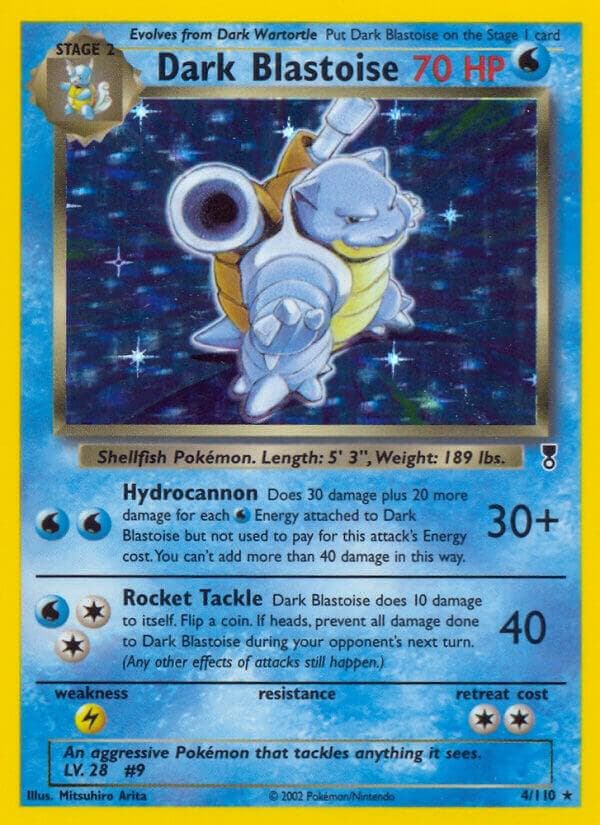
Dark Blastoise was already a known quantity by 2002. It first appeared in Team Rocket, and Legendary Collection brought it back as card 4/110. What changed was the packaging. Legendary Collection introduced reverse holofoil cards to the Pokemon TCG, with that firework pattern blanketing the whole card face. For a master-set builder that means this single Pokemon shows up in two distinct foil treatments you both need to chase.
“First Pokemon set to introduce reverse holofoil cards, the set's signature feature”
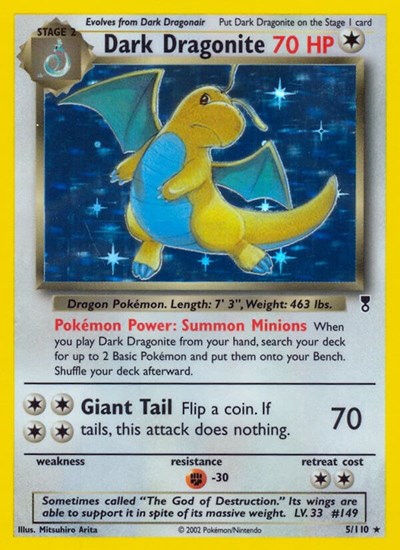
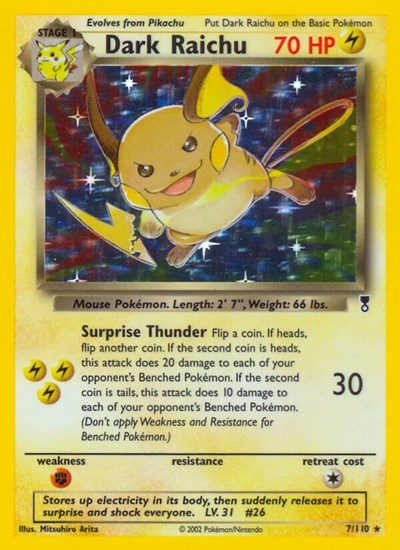
The regular Rare Holo uses the older star-style foil window on the artwork, which sets it apart from the cosmos holo collectors saw in later sets. The reverse holo is the version most people picture when they think of Legendary Collection. Dark Blastoise was also one of the four Pokemon chosen for the set's oversized box-topper cards, alongside Charizard, Dark Raichu, and Mewtwo, which adds a third printing for completists who want the jumbo.
That layering of variants is the appeal. One card, several legitimate targets, all anchored to a set that vintage collectors treat as a milestone.
By the numbersMarket analysis
Dark Blastoise is a mid-tier name in Legendary Collection, not a headline chase like Charizard, but the Dark prefix and the Blastoise lineage keep steady eyes on it. Raw copies in clean shape trade in the low three figures, and the reverse holo carries a clear premium over the standard Rare Holo.
Vintage WOTC-era holos from 2002 have drifted upward over the long run as supply tightens and graded population stays thin. Day to day it is quiet, but the floor on clean copies has held.
Treat it as a vintage hold, not a flip. The reverse holo and high-grade copies are where the durable value sits. Raw mid-grade copies are easy to find, so the upside lives in condition and the harder variants.
High-grade graded copies command a large multiple over raw, and gem-mint examples jump sharply again given how few survive with clean edges and centering. Reverse holo gem copies are the scarcest and priciest of the bunch.
Legendary Collection predates modern rarity tiers, so there are no published per-pack odds the way newer sets quote them. As a holo Rare it sat in the holo slot of its packs, sharing that slot with the rest of the set's holos, which makes any one specific holo a meaningful pull. The reverse holo was the set's signature insert, distributed at random through packs. The jumbo box topper came only inside sealed booster boxes, one box topper per box drawn from a pool of four cards. In practice the standard Rare Holo is the easiest version to find, the reverse holo is tougher, and the box-topper jumbo is the hardest of the three to track down.
Within Legendary Collection it ranks below the marquee Charizard, Blastoise, and Venusaur holos on price, but the Dark prefix and Arita art keep it ahead of most of the set's lesser reverse holos.
ArtworkWhy the art matters

Mitsuhiro Arita is one of the most recognizable names in early Pokemon TCG art. He painted the Base Set Charizard, and his work defines the look of the WOTC era. Collectors actively seek out his vintage pieces, and his name on a card is a draw in its own right.
The art shows Dark Blastoise in an aggressive pose, leaning into the flavor that frames it as a Pokemon that tackles anything in its path. The Dark variant trades the calm of a standard Blastoise for a more hostile posture, which fits the Team Rocket origin of the card.
The standard Rare Holo uses the older star-style foil window confined to the art box. The reverse holo flips that, applying the Legendary Collection firework pattern across the card body instead. Same illustration, two very different in-hand looks.
Arita art on a Team Rocket Dark Pokemon, dropped into the debut reverse holo set, is a combination that punches above the card's raw price. It is a recognizable name doing recognizable work in a landmark release.
BackgroundAbout Dark Blastoise
Blastoise is the final evolution of Squirtle, one of the three original Kanto starters from Red and Blue. Its Base Set card is a hobby cornerstone, so any Blastoise printing inherits a piece of that demand. The Dark Blastoise version comes from the Team Rocket storyline, where Team Rocket corrupts well-known Pokemon, and Legendary Collection reprinted it for a new audience.
- ›Starter-line evolution with permanent nostalgia value
- ›Connection to the iconic Base Set Blastoise
- ›Dark Pokemon flavor tied to the Team Rocket arc
- ›Saw real competitive play in the WOTC era through water-energy acceleration strategies
- ›Team Rocket expansion, its original printing
- ›Legendary Collection, the reprint covered here and one of four box-topper subjects
Long retired from any current format. Its relevance now is historical and aesthetic. In the WOTC era, Blastoise decks built around fast water-energy attachment were a defining archetype, and the Dark variant fed off that same playstyle.
Own it wellCollector guide
Vintage WOTC holos are prone to edge whitening and holo scratching. Check the four corners and the holofoil surface under angled light. On the reverse holo, the full-card firework pattern shows surface wear and print lines more readily than a standard holo window, so inspect it carefully.
Worth grading if the copy is genuinely clean, especially the reverse holo or a gem-mint candidate. Centering is the usual killer on this era, so eyeball front and back centering before paying grading fees. For a worn raw copy, grading rarely pays off. Read the grading guide →
Penny sleeve plus a top loader or one-touch for anything you care about, and keep it out of direct light to protect the foil. A graded slab just needs a stable, dry spot away from heat. See the storage guide →
Decide which variant you actually want before buying, because the standard holo, the reverse holo, and the jumbo trade at different levels. For anything beyond a casual raw copy, buy graded from a reputable seller. This is an early-2000s card, so authentication matters. See the singles buying guide →
WOTC-era cards are widely counterfeited, so verify before spending real money. Do the light test to confirm the black core layer inside the cardstock. Feel the surface texture, since genuine cards have a specific linen-like finish that reprints miss. Watch how the holo moves under light, as fakes often look flat or wrong-colored. Check the back swirl gradient and color, a common tell on counterfeits. When in doubt, buy a graded copy from a trusted grader.
Protect your card
High Chase Score — protect and consider grading. · Amazon affiliate links · Storage guideWord on the streetCommunity sentiment
Collectors regard Legendary Collection fondly as the set that started reverse holos, and Dark Blastoise rides that goodwill. It reads as a solid, recognizable vintage holo rather than a top-tier grail, which suits builders who want quality without grail-level prices.
Discussion tends to center on the set as a whole, the firework reverse holos, and the box-topper jumbos. Dark Blastoise comes up most often alongside Dark Raichu as one of the more wanted Dark Pokemon in the set.
Good to knowFrequently asked questions
Keep collectingRelated cards


Plan your Other Legendary Collection master set
Track every card, see what you're missing, and lay out your binder page by page.