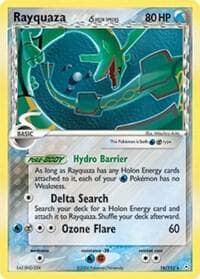
Rayquaza 016 110 Delta Species
Quick take
- Delta Species Rayquaza recolored Water and Metal, marked with the delta symbol
- Illustrated by Mitsuhiro Arita, the artist behind the original Base Set Charizard
- A standard Holo Rare, a tier below the set's ex and Gold Star chase cards
- One of two Rayquaza in Holon Phantoms; this is the 16/110 printing
Collector's readWhat it means for your master set
Set landscapeWhere this card sits in EX Holon Phantoms
VariantsCard variants
Variants are the different finishes of the same card — the standard print, reverse holo, and any special patterns. A complete master set needs every variant below, so track each one in your collection.
| Variant | Note | Market |
|---|---|---|
| Reverse Holo 16/110 | Reverse-holo variant. | $961.99 |
| Holofoil 16/110 | Holofoil variant. | $520.76 |
The storyArita's Delta Rayquaza, a cult favorite from the Holon era
Holon Phantoms landed in 2006 as part of the EX series, and its hook was Delta Species: familiar Pokemon printed in types they have no business being. Rayquaza got the treatment twice in this set. This one, number 16/110, is the Water and Metal version, and Mitsuhiro Arita handled the art.
“Delta Species Rayquaza recolored Water and Metal, marked with the delta symbol”
That combination is why collectors care. Rayquaza is one of the most popular Pokemon in the franchise, and Arita is the artist behind the original Base Set Charizard. Delta Species cards have a small but loyal fanbase who chase the whole off-canon idea. Put those things on one Holo Rare and you get a card that punches above its rarity slot.
It is not a Gold Star and it is not an ex, so it sits a tier below the set's true chase cards. As a recognizable, attractive, name-driven vintage holo, though, it is one of the more wanted Holo Rares from the Holon block.
By the numbersMarket analysis
For a plain Holo Rare, this card sits surprisingly high, in solid three-figure territory for a clean raw copy. The premium is almost entirely the name and the artist, not the rarity slot. It trades well below the set's ex cards and at a small fraction of the EX Deoxys Rayquaza Gold Star that shares the Pokemon.
Vintage EX-era holos of popular Pokemon have trended up over the long run as clean copies thin out. This one rides the broader Rayquaza demand curve rather than moving on its own. Expect graded gem-mint examples to keep separating from raw and played copies.
This is a name-and-art play, not a rarity play. The card should hold and slowly appreciate on Rayquaza and Arita demand, but it will never behave like the ex or Gold Star cards in the same set. Buy it because you want it in the binder, and grade the cleanest copy you can find if you want upside.
High-grade gem-mint copies command a clear premium over raw, and the gap widens because centering and holo wear on a 2006 card make true gem examples scarce. Mid-grade graded copies trade much closer to clean raw.
This predates modern published pull rates, so think in era terms rather than exact odds. As a Holo Rare from a 2006 EX-series set, it sat in the rare holo slot of booster packs. That made it far more common than the set's Gold Star chase cards, which in EX-era boxes pulled at roughly one per two booster boxes, around one in seventy-two packs. The Delta Rayquaza was a normal holo pull by comparison, with a reverse holo version also in circulation. Sealed Holon Phantoms product is now scarce and expensive, so almost all copies today come from the singles market.
Compared to the EX Deoxys Rayquaza Gold Star, this is night and day in scarcity and price. Within Holon Phantoms it sits below the ex cards and Gold Stars but above the non-holo rares. On the strength of the Pokemon and the artist, it is one of the more wanted Holo Rares in the set.
ArtworkWhy the art matters

Mitsuhiro Arita is one of the most famous illustrators in Pokemon TCG history. He painted the original Base Set Charizard, Blastoise, and Venusaur, and his work defined the look of the early game. By the EX era he was a known quantity, and his name on a card is a draw in its own right for collectors who follow artists.
Rayquaza is shown coiling through a dark, watery setting rather than its usual sky. The Delta Species recolor leans into cooler Water and Metal tones instead of the serpent's usual green. That shift is part of what makes the card read as off-canon and gives it its appeal.
Standard 2006 EX-series Holo Rare with the era's holofoil pattern across the artwork window. The small delta symbol marks it as a Delta Species card. A reverse holo printing exists, and a stamped prerelease variant exists as a separate collectible.
This is the rare case where a plain Holo Rare carries real weight. It stacks a beloved Pokemon, a legendary illustrator, and the cult Delta Species concept onto one card that stays affordable by vintage standards.
BackgroundAbout Rayquaza 016 110 Delta Species
Rayquaza is the Sky High Pokemon and a Legendary from the Hoenn region, introduced in Ruby and Sapphire. It became a franchise icon through its role in the Emerald arc and its later Mega and shiny forms. In the TCG it has appeared across dozens of sets and is one of the most consistently chased Pokemon for collectors.
- ›Iconic Legendary with massive franchise recognition
- ›Strong shiny and Mega-form following that spills into card demand
- ›Long history of desirable TCG printings across many eras
- ›The Delta Species recolor gives this version a distinct identity
- ›The famous Rayquaza Gold Star in EX Deoxys, one of the priciest vintage cards in the hobby
- ›The box Legendary in Pokemon Emerald, where it ends the Kyogre and Groudon conflict
- ›A recurring chase card across modern sets as a fan-favorite Legendary
In its day the 16/110 was a support-oriented Delta. Its Hydro Barrier Poke-BODY removed Weakness from your Water Pokemon while it held Holon Energy, and its Delta Search attack fetched a Holon Energy from the deck. It was built for the set's engine, not as a standalone attacker, and it is long out of any current format. Today its relevance is entirely as a collectible.
Own it wellCollector guide
Twenty-year-old EX-era holos commonly show edge whitening, surface scratches in the foil, and off-center cuts. Inspect the holo under angled light for print lines and scratching, and check all four corners. Centering on this era is hit or miss, so it matters a lot for grading.
Worth grading if you have a genuinely clean copy, since gem-mint examples separate hard from the pack on a card this old. For average or played copies, the grading fee rarely pays off; keep those raw in a sleeve and toploader. PSA, CGC, and Beckett are all fine choices. Read the grading guide →
Sleeve in a penny sleeve plus a snug toploader, or keep it in a graded slab. Store it out of direct light and humidity. Vintage foils are prone to clouding and curl, so avoid heat and store flat. See the storage guide →
Confirm you are buying 16/110 and not the 26/110 Rayquaza, and confirm holo versus reverse holo versus stamped, since prices differ. For higher spend, prefer graded copies or sellers with clear close-ups. For a master set, budget for both Rayquaza numbers and both reverse holos rather than just the headline card. See the singles buying guide →
Use standard vintage checks. Do a light test for the black core layer that genuine cards have between the front and back. Compare the back swirl and the blue gradient against a known-real EX-era card, check the font and the delta symbol placement, and feel the surface texture and foil behavior. EX-era holos do get faked, so for serious money buy graded from a reputable slab or a trusted seller with in-hand photos.
Protect your card
High Chase Score — protect and consider grading. · Amazon affiliate links · Storage guideWord on the streetCommunity sentiment
Collectors consistently rate this among the more attractive and desirable Holo Rares in Holon Phantoms. The reaction comes from the Rayquaza name, the Arita art, and the novelty of the Water and Metal Delta recolor, not from any competitive history.
It comes up regularly in Delta Species and EX-era nostalgia threads, and gets pulled into Rayquaza-collection and Arita-artist discussions. It reads as a steady, well-liked vintage piece rather than a hype card. Confusion with the EX Deoxys Gold Star is a recurring topic.
Good to knowFrequently asked questions
Keep collectingRelated cards


Plan your Other EX Holon Phantoms master set
Track every card, see what you're missing, and lay out your binder page by page.
More cards in Other EX Holon Phantoms
See all 111 cards → Kingdra Delta Species10/110
 Latias 011 110 Delta Species11/110
 Latios 012 110 Delta Species12/110
 Omastar Delta Species13/110
 Pidgeot Delta Species14/110
 Raichu Delta Species15/110
 Vileplume Delta Species17/110
 Absol18/110
 Bellossom Delta Species19/110
 Blaziken20/110
 Latias Delta Species21/110
 Latios Delta Species22/110