Zapdos H32
Quick take
- Holo Rare at H32 in Aquapolis, with a separate non-holo at 44/147 for master set builders
- e-Card era release from January 2003, one of WOTC's final Pokemon sets
- Art by Hajime Kusajima, who also drew the 2002 Japanese McDonald's promo Zapdos from the same period
- Kanto legendary bird pedigree keeps cross-collector demand alive
Collector's readWhat it means for your master set
Set landscapeWhere this card sits in Aquapolis
VariantsCard variants
Holofoil H32 · $290.00 — the only variant this card was printed in (no reverse holo or special pattern), so a master set needs just this one copy.
The storyAn e-Card era Zapdos holo from one of WOTC's last and hardest sets
Aquapolis landed in January 2003, deep in the e-Card era and right at the tail end of Wizards of the Coast's run with Pokemon. Zapdos sits at H32, the holo slot of a 147-card main set that also carried a parallel non-holo print at 44/147. If you are working an Aquapolis master set, you need both. The H32 holo is the one collectors actually chase.
“Holo Rare at H32 in Aquapolis, with a separate non-holo at 44/147 for master set builders”
The e-Card sets are remembered for two things. The dot-code strips along the card edges, meant for the Nintendo e-Reader peripheral, and the brutal condition curve. Aquapolis cards came out of packs with rough centering and chipping on the holo border far too often. That makes a clean H32 harder to find than the print run alone would suggest.
Zapdos itself carries weight no matter the set. It is one of the three Kanto legendary birds, a roster that has stayed relevant from the 1999 Fossil holos through Scarlet and Violet. That recognizability is a big part of why this specific holo holds steady demand among vintage buyers.
By the numbersMarket analysis
Raw copies trade as an accessible vintage holo, well below the set's headline crystal cards. Condition is the whole story here. A genuinely clean, well-centered copy commands a real premium over the played examples that dominate listings.
Prices for clean Aquapolis holos have firmed up over the last several years as the e-Card era got rediscovered by vintage buyers. Beat copies stay cheap and plentiful. The gap between a rough raw card and a graded gem keeps widening.
Steady, not explosive. This is a recognizable Pokemon on a thin, well-liked vintage set, which gives it a durable floor. The upside lives almost entirely in condition. A raw near-mint copy that grades well is worth far more than its raw price, so the play is finding clean cardboard and grading it.
Strong. Aquapolis holos are tough to find centered and chip-free, so PSA 9 and especially PSA 10 copies sell for multiples of raw. The premium on a true gem is one of the steeper ones you will see for a card at this price level.
Aquapolis split its lineup into a standard run and a separate holo set numbered with an H prefix, which is where this Zapdos lives at H32. Any given holo turned up roughly once per pack's holo slot, but pulling this specific Zapdos out of packs ran much longer than that, since you were fighting the full holo checklist. Most collectors today simply buy the single. The real constraint is not finding a copy, it is finding one with clean centering and no holo-edge chipping, which is genuinely scarce for this set.
Common as a card to source, hard to source clean. Set against the crystal cards that sit at the top of Aquapolis, this Zapdos is an everyday vintage holo. Within the legendary bird theme it slots between the cheaper modern Zapdos prints and the pricier 1999 Fossil holo.
ArtworkWhy the art matters
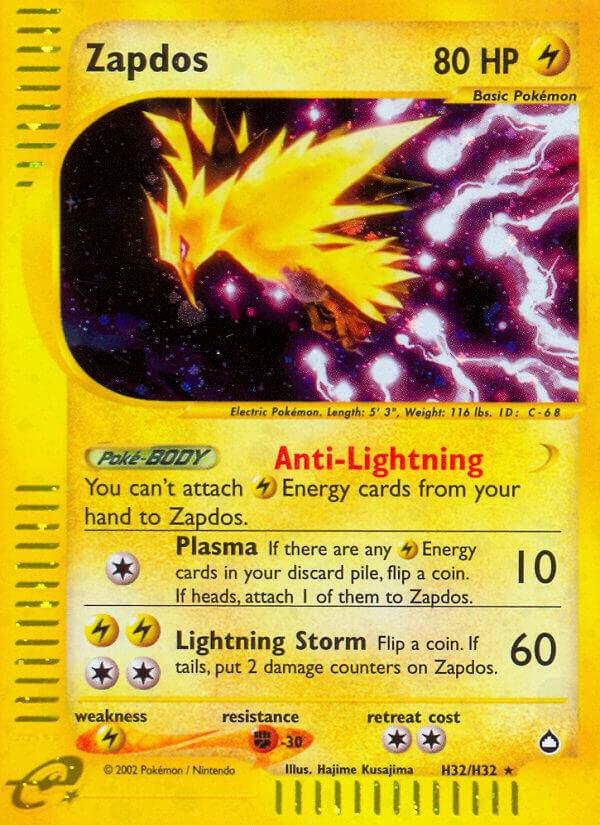
Hajime Kusajima illustrated a number of cards across the e-Card era and earlier WOTC sets. The same artist handled a separate Zapdos that went out as a 2002 Japanese McDonald's promo with different art, so there is a small Kusajima Zapdos thread for art-focused collectors to pull on.
The art shows Zapdos mid-flight, wings spread, with its jagged feathered crest and the spiky tail that reads instantly as the Electric bird. It is a clean creature portrait in the e-Card house style rather than a busy action scene.
Standard e-Card era holofoil applied across the illustration window, with the dot-code strip running along the card edge for the Nintendo e-Reader. The holo layer is exactly where Aquapolis cards tend to show edge chipping, so the foil border is the first thing to check on any copy.
It pairs a top-tier recognizable Pokemon with the specific look and quirks of the e-Card era. For collectors who like that the dot-codes scanned into a Game Boy Advance peripheral, this is a tidy piece of that short-lived experiment.
BackgroundAbout Zapdos H32
Zapdos debuted in Red and Blue as one of the three Kanto legendary birds alongside Articuno and Moltres. It has appeared in the TCG since the 1999 Fossil set and remains one of the most printed legendaries in the game. The trio's group identity keeps all three in steady rotation with collectors.
- ›One of the original three Kanto legendary birds, a set people collect as a unit
- ›Electric typing and a striking bird design that has stayed iconic since Gen 1
- ›Long TCG print history that gives players a deep card pool
- ›Cross-generational recognition from games, anime, and movies
- ›Fossil (1999), the original Kanto legendary bird holo trio in the TCG
- ›2002 Japanese McDonald's promo Zapdos (024/P), also illustrated by Hajime Kusajima with different art
Own it wellCollector guide
Check centering first, then the holo border for chipping, then the surface for the fine scratches that holo foil attracts. Aquapolis is one of the worst WOTC sets for off-center cuts, so a copy that is even close to centered is already above average. Inspect the dot-code edges too, since wear shows there fast.
Worth grading only if the raw copy is genuinely clean. Centering and edge chipping are what cap grades on this set, so a card that looks PSA 9 or better is the one to submit. A PSA 10 carries a heavy premium here. Mid-grade slabs rarely beat the cost of grading, so be honest about the card before sending it. Read the grading guide →
Sleeve and toploader at minimum, plus a perfect-fit inner sleeve if you intend to grade. Keep it out of direct light and humidity. Vintage holo foil can develop new chipping from handling, so minimize how often you take it out of the holder. See the storage guide →
For a binder copy, buy raw and prioritize centering over a tiny price difference, since a well-centered example costs little more now and is far better long term. For an investment piece, buy it already graded from a reputable seller and pay up for a clean PSA 9 or 10 rather than gambling on a raw card. See the singles buying guide →
Counterfeiting risk is lower than on Charizard-tier chase cards, but still verify the basics. Check the holo behavior under angled light, confirm the dot-code strip is crisp and correctly placed for an e-Card, and inspect the back swirl gradient and front texture. For any serious money, buy graded.
Protect your card
Low Chase Score — basic protection is plenty. · Amazon affiliate links · Storage guideWord on the streetCommunity sentiment
Well regarded as a clean, affordable way into the e-Card era and the legendary bird theme. Aquapolis set builders talk about it mostly in the context of condition, since everyone has a story about how hard it was to land a centered copy.
Quiet and steady rather than hyped. Discussion clusters around Aquapolis master set progress and the difficulty of finding gem-mint e-Card holos, not around big sales or speculation.
Good to knowFrequently asked questions
Keep collectingRelated cards


Plan your Other Aquapolis master set
Track every card, see what you're missing, and lay out your binder page by page.