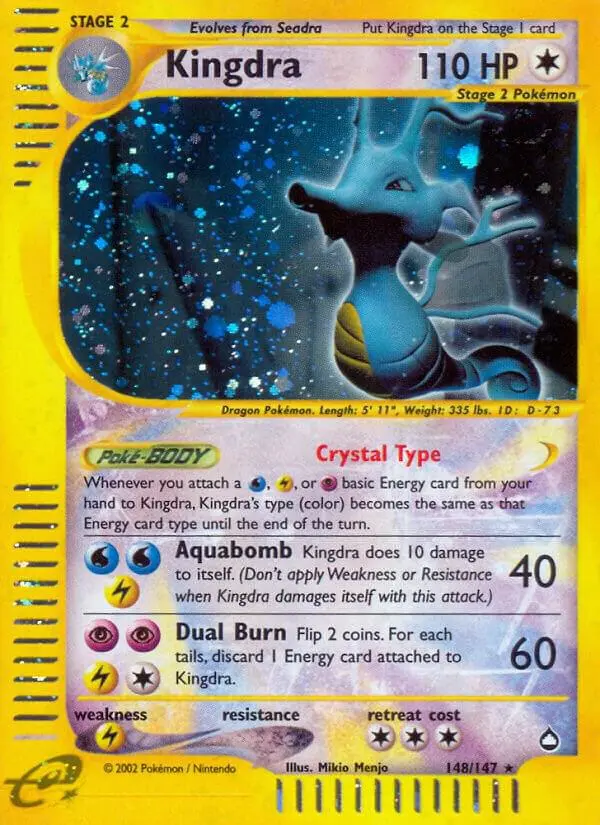
Kingdra 148
Quick take
- One of only three Crystal secret rares in Aquapolis, numbered 148/147
- The Crystal subtype debuted in this set, an e-Card era signature
- Released during the WotC-to-Nintendo handoff, so print runs were small
- The friendlier-priced way into the Crystal trio versus the Lugia
Collector's readWhat it means for your master set
Set landscapeWhere this card sits in Aquapolis
VariantsCard variants
Holofoil 148/147 · $457.00 — the only variant this card was printed in (no reverse holo or special pattern), so a master set needs just this one copy.
The storyA Crystal secret rare from the last great WotC-era set
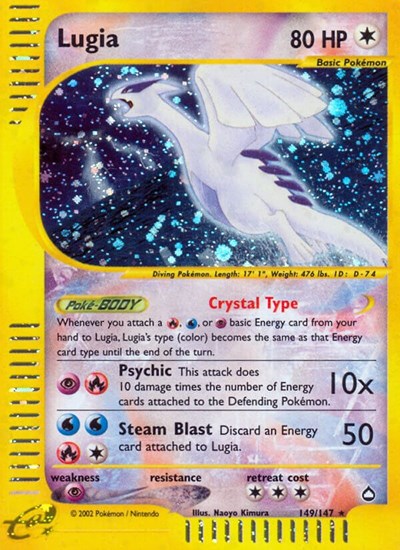
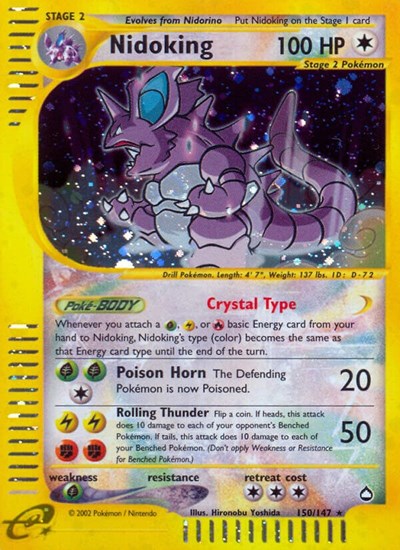
Aquapolis was the first English set to use the Crystal subtype, and it carried three of them. Crystal Kingdra sits at 148, Crystal Lugia at 149, and Crystal Nidoking at 150. They print past the numbered base set, which is why you see 148/147. That out-of-bounds number is the tell that you are holding a secret rare, not a regular holo.
“One of only three Crystal secret rares in Aquapolis, numbered 148/147”
Kingdra is the middle child here. Lugia is the card everyone chases, the one collectors compare to Base Set Charizard for the set. Nidoking and Kingdra ride in its wake. That actually works in a master-set builder's favor. You get the same Crystal foil, the same era, and the same scarcity, usually for a friendlier number than the Lugia.
What makes the trio matter is timing. Aquapolis came out in early 2003, right as Wizards of the Coast handed the license to Nintendo. Print runs were smaller than the boom-era sets before it. Crystal cards were brutal pulls. Two decades on, clean copies are thin on the ground.
By the numbersMarket analysis
Kingdra sits in the middle of the Aquapolis Crystal trio. The Lugia commands the set, with Nidoking and Kingdra trailing it. Raw copies in played condition are the most attainable entry point into Crystal cards. Anything in high grade jumps well above that.
Vintage e-Card secret rares have held and climbed over the long run as the supply of clean copies keeps shrinking. Demand is steady rather than spiky, driven by registry set builders rather than hype cycles.
A solid long-hold for a vintage collector. It is not the trophy of the set, so upside is steadier than the Lugia, but supply only tightens with time and the Crystal name keeps it on want lists. Condition is everything at this age.
Graded copies carry a heavy premium over raw, and that gap widens sharply at the top of the scale. Centering and surface on Crystal foil are tough, so high-grade population stays low and the best examples pull away from everything below them.
Crystal cards from the e-Card era were some of the hardest pulls of their time, landing at roughly one per booster box or even less. Aquapolis only had three of them, so the odds of pulling this specific Kingdra ran far longer than that, deep into box-after-box territory. Add the smaller print runs from the Wizards-to-Nintendo transition and you get a card that was scarce when it was new and is scarcer now in clean condition.
Within Aquapolis the Crystals sit above the regular holos and the rest of the rarity ladder. Across the e-Card era, the Crystal cards from Aquapolis and the later Skyridge set are treated as the top tier by registry collectors.
ArtworkWhy the art matters

Mikio Menjo illustrated cards across the early Pokemon TCG, with work spanning the Wizards of the Coast and e-Card era sets. His art shows up on a number of holos from this period.
Kingdra appears in an underwater setting that fits the seahorse-dragon Pokemon. The draw on a Crystal card is less the scene itself and more how it sits on the foil. The Crystal treatment runs the holo across the full background and behind the art, so the whole card reads as a single shimmering surface rather than a window of foil framed by border.
Crystal cards use a full-holo background with translucent text boxes layered over the iridescent foil. Under light the surface shifts with a gemstone-like glow. That layered foil is what separates a Crystal from a standard holo of the same era, and it is also what makes the card hard to grade clean.
The Crystal foil is the headline. It is one of the most recognizable looks in vintage Pokemon, and Aquapolis was where the subtype debuted in English. A Kingdra in that treatment carries the same visual punch as its more expensive Lugia sibling.
BackgroundAbout Kingdra 148
Kingdra is the final evolution of Horsea, a Water and Dragon seahorse from Generation II. It has stayed a fan favorite for that typing, which was rare and resilient when it debuted. On this card it is a Colorless Stage 2 with 110 HP and the Crystal Type Poke-Body.
- ›Water/Dragon typing that made Kingdra stand out in the early games
- ›Strong evolution-line nostalgia from the Horsea family
- ›The Crystal Type mechanic that shifts its color with the Energy you attach
- ›Steady appeal among Dragon-type collectors
- ›A signature of the Generation II Johto roster as Horsea's final form
- ›One of the three Crystal Pokemon featured in the Aquapolis set
This is a collector card, not a competitive one. It is long out of any sanctioned format, and the Crystal Type gimmick was always more flavor than function. Value here is entirely about rarity and the foil.
Own it wellCollector guide
Crystal foil shows wear easily. Look hard at the surface for scratches and print lines, and check the corners and edges where the foil chips. Centering is a common weak spot on these. Whitening on the back edges is normal for a card this old, but it caps the grade fast.
Worth grading if the copy is clean, since the graded premium on Crystal cards is large and grows at the top end. Be realistic about surface and centering before you pay for a slab. For any serious money, buy already graded from a reputable grader. Read the grading guide →
Sleeve and toploader at minimum, and use a sleeve that will not haze the foil. For long-term holding, a graded slab is the safest home. Keep it out of direct light and away from heat and humidity, which are rough on old foil. See the storage guide →
Vintage secret rares get faked. For raw copies, inspect carefully or buy from a seller who shows real photos under angled light. For anything above pocket money, buy graded so authentication is handled. The Kingdra is the value entry into the Crystal trio if the Lugia is out of reach. See the singles buying guide →
Run the standard vintage checks. Do the light test for the black core layer, since a genuine card has that dark middle layer when held to a strong light. Feel the surface texture against a card you trust. Watch how the holo behaves under angled light, because Crystal foil has a specific layered shimmer that is hard to fake. Check the back swirl gradient against a known-real Aquapolis card. When in doubt, buy graded.
Protect your card
High Chase Score — protect and consider grading. · Amazon affiliate links · Storage guideWord on the streetCommunity sentiment
Collectors love the Crystal cards as a group, and Kingdra gets affection as the more reachable member of the Aquapolis trio. It is widely seen as a smart pickup for anyone who wants the Crystal look without paying Lugia money.
Crystal Aquapolis and Skyridge cards are a recurring topic in vintage collecting circles, usually framed around how hard they were to pull and how scarce clean copies are now. Kingdra rides along in those conversations rather than leading them.
Good to knowFrequently asked questions
Keep collectingRelated cards


Plan your Other Aquapolis master set
Track every card, see what you're missing, and lay out your binder page by page.