Lugia
Quick take
- One of three Crystal-type secret rares in Aquapolis, and the most chased of the three
- Crystal Pokemon were the first of their kind in the English TCG
- No reverse holo printing exists, so supply stays thin
- The make-or-break card for any Aquapolis master set
Collector's readWhat it means for your master set
Set landscapeWhere this card sits in Aquapolis
VariantsCard variants
Holofoil 149/147 · $4500.00 — the only variant this card was printed in (no reverse holo or special pattern), so a master set needs just this one copy.
The storyThe headline chase of Aquapolis
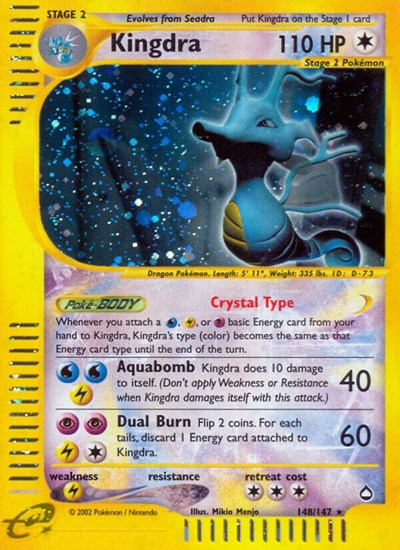
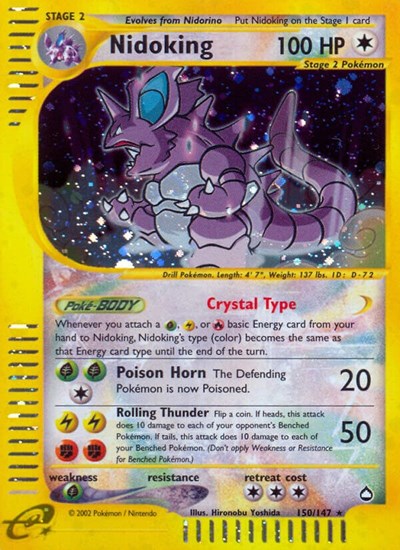
Aquapolis landed in early 2003 and it was a big set. The numbered list runs to 147, but the real card count climbs much higher once you fold in the holo and reverse variants, which puts it among the largest English expansions ever printed. Tucked at the very end of the checklist are three Crystal-type secret rares: Nidoking, Kingdra, and Lugia. The Lugia is the one everybody wants.
“One of three Crystal-type secret rares in Aquapolis, and the most chased of the three”
Crystal Pokemon were brand new to the English game here. The hook is the Crystal Type Poke-Body, which lets Lugia change its type to match whatever basic Energy you attach. In play it was a curiosity. As collectibles, these became the headline acts of the e-Card era. Unlike the Crystal cards that followed in Skyridge, the Aquapolis trio were never available as reverse holos, so there is exactly one printing to hunt.
For a master set of Aquapolis, this card is the finish line. The commons, uncommons, and holos come together at reasonable cost. The secret rare Lugia is where the budget goes. Anyone serious about completing this set has to plan around it from day one.
By the numbersMarket analysis
Crystal Lugia sits firmly at the top of the Aquapolis price ladder. It is a vintage secret rare from a beloved set with a marquee Pokemon, which lands it in solid four-to-five-figure vintage territory depending on grade. The other two Crystals from the set trade lower, so the Lugia carries the set on its own.
Vintage e-Card secret rares have trended up over the long run, tracking the broader rise in early-2000s graded vintage. Lugia as a character adds a layer of demand that the Nidoking and Kingdra do not get. Condition matters a lot here, with a wide gap between a played raw copy and a high-grade slab.
This is a blue-chip vintage piece. Demand comes from both set builders and Lugia fans, which gives it a deeper buyer pool than most e-Card secrets. The main risks are condition and authenticity rather than demand. A graded copy from a trusted slab is the safer long hold.
The premium for high grades is steep. e-Card holos are prone to surface and edge wear, so clean Gem Mint copies are scarce and command a large multiple over raw and over lower grades. Most serious money in this card moves in graded form.
Aquapolis predates the modern published pull-rate framework, so exact odds were never officially documented. What collectors know from opening the era is that secret rares like the Crystal Lugia sat at the deep end of the rarity scale, well rarer than the standard holos, and the e-Card series saw limited print and distribution during a market cooldown. In practice, pulling a specific Crystal from sealed product is a long-odds event measured in many boxes. That is a big part of why most copies today trade as singles rather than fresh pulls.
Within Aquapolis, the Crystal trio sits above everything else, and the Lugia sits above the Nidoking and Kingdra on demand. Against modern chase cards, think of it the way you would a top Special Illustration Rare in a Scarlet and Violet set, but with the added scarcity and condition risk of a vintage holo that has been in circulation for over twenty years.
ArtworkWhy the art matters

Naoyo Kimura illustrated cards across the e-Card era and earlier Pokemon TCG sets. Kimura's work tends toward clean, character-forward compositions. The Crystal Lugia is among the most prominent cards in that catalog, given its status as the Aquapolis chase.
Lugia is shown mid-flight with its long wing fingers spread, rendered in the cool blue and white palette the character is known for. The Crystal treatment gives the card its faceted, gem-like holo pattern rather than a standard cosmos or starlight foil, and that is what sets the three Aquapolis Crystals apart from the rest of the set.
This is a holographic secret rare in the e-Card layout, complete with the e-Reader dot-code strips along the bottom and side that defined the era. The Crystal foil pattern makes the card immediately identifiable, and it is also part of what makes counterfeits easy to spot once you know how the genuine holo behaves.
This is the card people open Aquapolis for. A top-tier legendary, the first-of-its-kind Crystal mechanic, and a single non-reverse printing combine into one of the most iconic cards of the e-Card period.
BackgroundAbout Lugia
Lugia debuted as a Legendary Pokemon in the second generation and became a face of the franchise through the second movie and Silver version cover art. That mainstream recognition carries straight into the card market. A Lugia card with strong art and real scarcity tends to outperform comparable cards of less famous Pokemon, and the Crystal Lugia is a textbook example.
- ›Lugia is a cover legendary with broad recognition well beyond hardcore TCG collectors
- ›The cool, dragon-like silhouette is one of the most liked legendary designs
- ›Crossover demand from movie and video game fans deepens the buyer pool
- ›As the Aquapolis chase, it inherits the set's nostalgia from early-2000s players
- ›Headline legendary of the second generation games, Gold and Silver
- ›Central role in the second Pokemon movie, The Power of One
Own it wellCollector guide
e-Card holos are notorious for edge whitening, surface scratches, and print lines. The dark border shows wear fast, so inspect corners and edges closely. The faceted Crystal foil can hide light scratches under certain angles. Check the card in good light from multiple directions before trusting a raw copy.
For any meaningful spend, buy it already graded by a major service or budget for grading. The price gap between grades is large enough that authentication and condition certainty are worth the fee. A raw copy at full money without a slab is a risk most collectors should not take. Read the grading guide →
Treat it like the vintage holo it is. Penny sleeve plus a snug top loader, or better, a graded slab. Keep it out of direct light and away from humidity. The dark borders and Crystal foil both punish handling, so minimize how often it leaves protection. See the storage guide →
Decide up front whether you want a graded copy or a raw one you trust. For graded, stick to recognized slabs and verify the cert. For raw, buy from sellers with clear, high-resolution photos of front, back, and edges, and lean on the authentication checks below. This is one of the more faked vintage cards, so patience beats a rushed deal. See the singles buying guide →
Fakes of vintage holos like this turn up regularly, so verify before you pay. Do a light test: hold the card up to a bright light and look for the thin black core layer sandwiched inside genuine cards, which most counterfeits lack. Feel the surface texture, since real e-Card stock has a specific finish that cheap reprints get wrong. Watch how the holo behaves as you tilt it, looking for the genuine Crystal foil pattern rather than a flat or grainy fake. Inspect the back swirl gradient and color, a frequent giveaway on counterfeits. For serious money, buy graded and confirm the cert.
Protect your card
High Chase Score — protect and consider grading. · Amazon affiliate links · Storage guideWord on the streetCommunity sentiment
The Crystal Lugia is widely treated as the crown jewel of Aquapolis and one of the standout cards of the e-Card era. Vintage collectors and Lugia fans both rank it highly, and it routinely shows up on lists of the most desirable secret rares of the early 2000s.
Discussion tends to focus on condition and authenticity, given the card's age and the volume of counterfeits in circulation. High-grade copies draw attention when they surface, and the card is a regular reference point in conversations about the most valuable e-Card secrets.
Good to knowFrequently asked questions
Keep collectingRelated cards


Plan your Other Aquapolis master set
Track every card, see what you're missing, and lay out your binder page by page.