Blastoise
Quick take
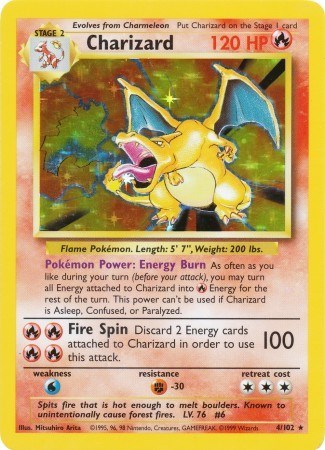
- One of three Base Set holofoil starters (#2 Blastoise, #4 Charizard, #15 Venusaur)
- Mitsuhiro Arita illustration, one of the most-reproduced Pokemon images ever
- Three print variants: 1st Edition (grail), Shadowless (mid), Unlimited (entry)
- Unlimited Holofoil ~$159 raw, Shadowless ~$500-700, 1st Edition $3,000-5,000+
Collector's readWhat it means for your master set
Set landscapeWhere this card sits in Base Set
VariantsCard variants
Holofoil 2/102 · $222.49 — the only variant this card was printed in (no reverse holo or special pattern), so a master set needs just this one copy.
The storyOne of Three Cards That Founded the Hobby
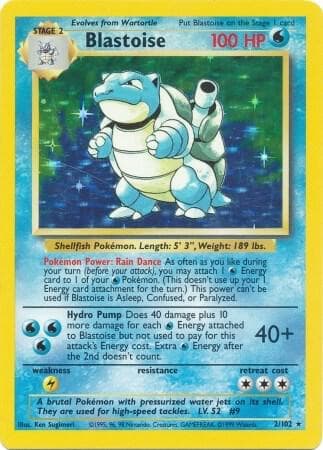
The Pokemon TCG Base Set released in English on January 9, 1999. Three holofoil starters anchored the chase ladder. Charizard at #4 became the card every kid in 1999 wanted. Venusaur at #15 was the third starter, often the value buy. Blastoise was the powerhouse, high HP, Hydro Pump attack, and the iconic water-cannon turret pose by Mitsuhiro Arita.
“One of three Base Set holofoil starters (#2 Blastoise, #4 Charizard, #15 Venusaur)”
Three print variants exist for English Base Set Blastoise. 1st Edition (rarest, with the small '1st Edition' stamp). Shadowless (printed before the drop-shadow was added to the card art frame). Unlimited (the most common production). Unlimited Holofoil settles around $159 raw. Shadowless typically trades 4-5x higher. 1st Edition Holofoil is grail tier, PSA 10 copies regularly clear $20,000+ at major auctions.
The card defined what 'rare and holofoil' meant for a generation. The water-cannon image has been reprinted dozens of times across 25+ years, every Base Set classic reprint, every anniversary, every nostalgic callback comes back to this illustration. Owning the original 1999 print is owning a piece of the franchise's foundation. That's the appeal that's held the card's value through every TCG market cycle since.
By the numbersMarket analysis
Unlimited Holofoil around $159 raw on TCGPlayer at last sync. Shadowless Holofoil typically $500-700 raw. 1st Edition Holofoil $3,000-5,000+ raw, with PSA 10 copies above $20,000. Base Set pricing has been resilient across multiple TCG market cycles because the supply pool is closed and demand grows with each new generation of returning collectors.
Vintage Base Set has appreciated structurally for two decades with cyclical corrections. Unlimited Holofoil bottomed near $40-60 in the early 2010s, ran to $200+ during the 2020-2021 pandemic-era TCG boom, corrected to $100-120 through 2023, and has steadied around $150-170 since the 25th anniversary nostalgia wave. PSA 10 graded comps follow the same shape with wider amplitude.
Strong long-term fundamentals. Base Set's appreciation is supported by closed supply plus growing demand from each new generation of returning collectors. Unlimited Holofoil is the entry-tier vintage purchase, affordable enough for new collectors to start, scarce enough to hold value. Shadowless and 1st Edition variants offer higher upside but at higher capital commitment. PSA 10 graded copies of Unlimited Holofoil trade meaningfully above raw.
PSA 10 copies of Unlimited Holofoil command 2-3x raw, call it $300-500 for clean grade. Centering on the long axis is the main grading variable. Base Set's print quality was inconsistent enough that PSA 10 examples are genuinely scarce. Submit only copies with strong centering and clean edges.
1999 Base Set holofoils pulled at roughly 1 in 11 packs across all three holo starters plus other Rare Holos in the set. Per specific holo, roughly 1 in 33 packs at the original print run pull rates.
One of three Base Set holofoil starters. Charizard #4 is the headline chase ($300+ Unlimited, $5,000+ 1st Edition PSA 10). Blastoise #2 in the middle. Venusaur #15 the value tier. The trio is treated as a paired chase by Base Set collectors, most target all three together.
ArtworkWhy the art matters

Mitsuhiro Arita is the original Pokemon TCG illustrator behind most of the Base Set's most iconic cards. Charizard, Blastoise, Venusaur, Mewtwo, Pikachu, all Arita illustrations from the 1999 print. His work defined the visual identity of the early TCG. Arita has continued illustrating Pokemon cards for 25+ years, with later contributions including modern Base Set tribute reprints and 25th anniversary cards. The Base Set Blastoise is among his most-reproduced individual works.
Blastoise in a slight ground-stance crouch with the two shoulder-mounted water cannons fully extended forward. The Pokemon's blue colour dominates the lower half of the card. The upper-right corner shows the cannon barrels in profile against a darker shaded background. The composition leans into Blastoise's bulk, heavy frame, planted feet, weapons primed.
Holofoil rarity uses the classic late-90s 'cosmos' holofoil pattern across only the art panel, not the full card. The frame and typography are matte. Shadowless versions lack the drop shadow behind the right-side art panel border (the Base Set printing run added the shadow partway through, distinguishing Shadowless from Unlimited). The cosmos foil shifts colour and reflection angle as the card tilts, distinct from any modern holofoil pattern.
Modern alt arts compete on illustration density and composition complexity. Base Set Blastoise wins on icon status alone. The image has been reproduced in commercials, manga, anime title cards, video game opening sequences, anniversary merchandise, and countless TCG reprints. Owning the original print connects the collector to that 25+ year reproduction chain.
BackgroundAbout Blastoise
Blastoise debuted in Pokemon Red and Green (1996) as the final evolution of the Water-type starter Squirtle. National Pokedex #009. Water-type. Signature move Hydro Pump in early-gen mechanics. One of the three Generation I starter finals alongside Charizard (Fire) and Venusaur (Grass). Mega-evolves into Mega Blastoise in Generation VI (X/Y Mega Evolution, 2013), with a single large cannon replacing the two shoulder turrets. Has appeared in every mainline Pokemon game since 1996.
- ›Original Generation I starter, automatic legacy status
- ›Iconic Mitsuhiro Arita illustration from the Base Set
- ›Mega Blastoise design from Gen VI gave the Pokemon a modern resurgence
- ›Pokemon Master Set inclusion, required for any era-spanning master set collection
- ›Crossover appeal across competitive, casual, and collector audiences
- ›Generation I in Pokemon Red/Green/Blue (1996-1998)
- ›Multiple anime series including Gary Oak's signature Blastoise
- ›Pokemon Stadium / Stadium 2 prominent feature
- ›Mega Blastoise in Pokemon X/Y (2013) and Omega Ruby/Alpha Sapphire (2014)
- ›Detective Pikachu (2019) film cameo
Blastoise has been a stable Water-type pick across multiple generations with viable Hydro Pump / Surf / Ice Beam / Earthquake coverage. Mega Blastoise in X/Y pushed the Pokemon into OU briefly via Mega Launcher boosting Aura Sphere and Water Pulse. The Base Set TCG card has playable stats for the early-gen TCG format but is universally a display piece today.
Own it wellCollector guide
Vintage Base Set cards from 1999 have predictable issues. Edge whitening. Surface scratches on the cosmos holofoil. Centering drift (Base Set's print quality was inconsistent). Corner wear on cards that spent years in non-archival storage. The holofoil panel scratches more easily than the matte frame. Inspect under angled light for any haze or texture inconsistency.
Grade clean copies, the premium is substantial. Unlimited Holofoil PSA 10 commands 2-3x raw. Shadowless and 1st Edition variants justify grading even on near-mint copies given the rarity. Verify centering at 55/45 or better, Base Set's known print quality issues mean PSA 10 grades are scarcer than for modern cards. PSA is the canonical grader for vintage. Read the grading guide →
Penny sleeve plus rigid top loader minimum. For raw long-term hold, magnetic case is the gold standard. Climate-controlled storage is non-negotiable at this age, humidity and temperature cycling over 25+ years is the primary degradation vector. Graded slabs provide best protection for raw copies intended for long holds. See the storage guide →
Decide variant first. Unlimited Holo (entry tier, ~$159), Shadowless ($500-700), or 1st Edition ($3,000+). Unlimited is the right buy for collectors targeting Base Set without going deep on vintage. eBay's PSA-verified market is the deepest pool for graded copies. TCGPlayer for raw, inspect photos carefully because many listings underdescribe condition issues. For 1st Edition specifically, only buy graded from a reputable seller. See the singles buying guide →
Counterfeit Base Set cards are rampant given the price point and 25+ year history. Verify weight, cardstock thickness (vintage Pokemon cards are noticeably thicker than counterfeit reprints), back colour and centering, and the holofoil pattern. The original Base Set holofoil 'cosmos' pattern is hard to replicate accurately. Buy from reputable vintage dealers or graded slabs from PSA, CGC, or BGS for any significant purchase.
Protect your card
High Chase Score — protect and consider grading. · Amazon affiliate links · Storage guideWord on the streetCommunity sentiment
Universal positive. Base Set Blastoise is a foundational card, there's no negative discourse around it. Every era of returning collector has rediscovered this card, and each rediscovery cycle adds to the cultural weight. The water-cannon image is shorthand for 'vintage Pokemon TCG' in collector culture.
- ›1st Edition Holofoil PSA 10 sales regularly clear $20,000+ at major auction houses
- ›Shadowless Holofoil PSA 10 in the $5,000-8,000 range
- ›Unlimited Holofoil PSA 10 in the $300-500 range
- ›Raw Unlimited Holofoil around $159 on TCGPlayer market
Constant. The card features in every 'best vintage Pokemon TCG' video, every binder tour from collectors who started in the 90s, every Base Set tribute discussion. Mitsuhiro Arita's illustration is one of the most-reproduced Pokemon images ever, which keeps the card in cultural circulation indefinitely.
Good to knowFrequently asked questions
Keep collectingRelated cards


Plan your Other Base Set master set
Track every card, see what you're missing, and lay out your binder page by page.