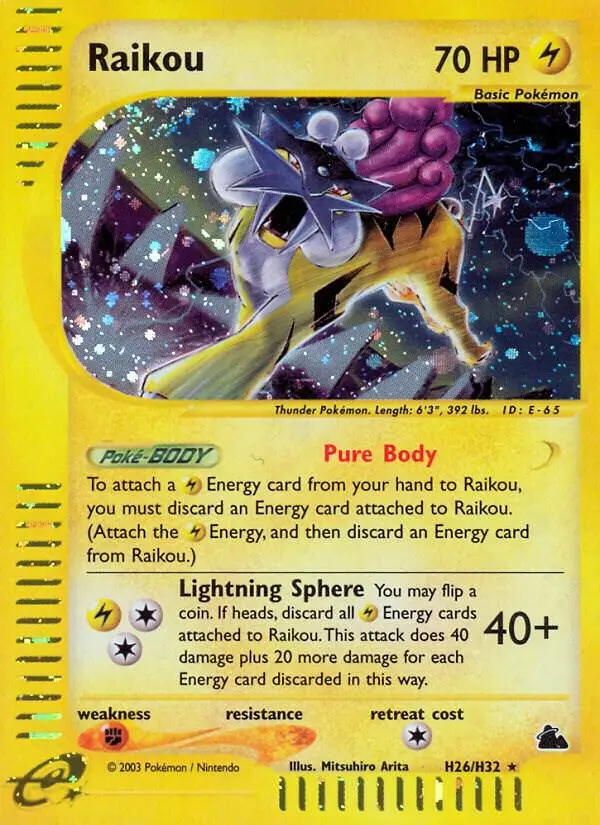
Raikou H26
Quick take
- Holo Rare from Skyridge, the last WOTC English set
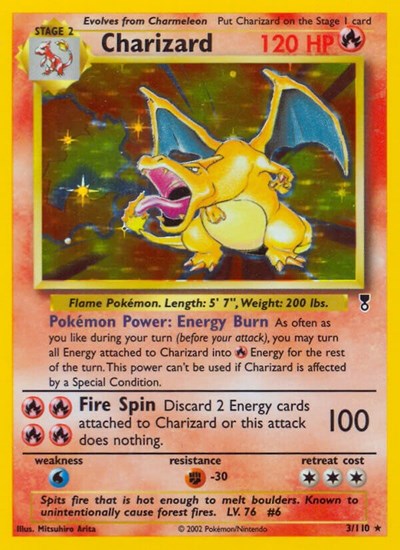
- Illustrated by Mitsuhiro Arita, the Base Set Charizard artist
- Sits in the H1-H32 holo subset as H26
- One of the three legendary beasts collectors chase as a trio
Collector's readWhat it means for your master set
Set landscapeWhere this card sits in Skyridge
VariantsCard variants
Holofoil H26 · $375.00 — the only variant this card was printed in (no reverse holo or special pattern), so a master set needs just this one copy.
The storyAn Arita legendary from the final WOTC set
Skyridge closed out the e-Card era in 2003. It was Wizards of the Coast's last English set before The Pokemon Company took the license in-house, so every holo in the set carries a built-in end-of-an-era story. Raikou lands at H26 in the holo subset, the run of foil cards numbered H1 through H32 that sit apart from the 144-card main set.
“Holo Rare from Skyridge, the last WOTC English set”
The name on the card matters here. Mitsuhiro Arita has been drawing Pokemon cards since the very first set in 1996, and his Base Set Charizard is one of the most recognizable pieces of card art in the hobby. A legendary beast under his brush, in the last WOTC set, is the kind of combination master-set builders circle early.
Raikou carries weight beyond the cardboard too. It is the Lightning member of the three legendary beasts from Gold and Silver, a trio a lot of collectors chase together. That cross-set pull keeps demand steadier than a typical mid-set holo from the period.
By the numbersMarket analysis
Raw copies in clean near-mint condition sit comfortably in the middle of the set's pricing, below the Skyridge crystal cards but well above the bulk holos. It is a vintage card with a real floor, not a speculative flip.
Skyridge singles have drifted up over the long run as sealed product dried up and the WOTC era cemented its status with collectors. Raikou tracks that slow climb rather than spiking. Graded gem examples have pulled away from raw the most.
Treat this as a hold rather than a trade. The supply story is locked, the set is finished, and the artist name does not get less valuable over time. The real risk is condition. A raw copy that grades poorly can sit well under the gem price, so the value lives in the grade.
The jump from raw to a top grade is steep on this card, sharper than on most period holos, because e-Card cards are tough to grade well. A PSA 10 commands a strong multiple over a raw near-mint copy, and even a PSA 9 carries a meaningful premium.
This is a vintage e-Card holo, so it does not follow modern booster odds. Skyridge holos were classic short-print foils, and a specific holo like Raikou runs long across a box rather than turning up every few packs. Skyridge in particular had a low print run for the era and is one of the harder WOTC sets to complete, which is why clean copies of any holo, Raikou included, are scarcer than the simple rarity stamp suggests. For a sense of how vintage chase odds compare to the EX era that followed, Gold Star cards (a Pokemon shown with a gold star, illustrated mostly by Masakazu Fukuda between 2004 and 2007) sat at roughly one per two booster boxes, about 1 in 72 packs, with EX Power Keepers running a little more generous at one to two per box. Raikou is not a Gold Star, but the takeaway holds. Vintage chase foils show up far less often than modern hits.
Inside Skyridge, the crystal-type secret rares (Charizard, Celebi, Crobat, Golem, Ho-Oh, Kabutops) are the headline chases and price well above Raikou. Among the standard H-holos, an Arita legendary like Raikou sits toward the more desirable end.
ArtworkWhy the art matters

Arita has worked on the Pokemon TCG since its planning stages in 1996 and illustrated cards from the very first set. He painted the Base Set Charizard, probably the single most famous card in the hobby. His name alone adds a premium to almost any card he touches, and his legendary and starter pieces are among the most collected art in vintage Pokemon.
Arita renders Raikou in his classic painted e-Card style, the Lightning beast shown as the powerful quadruped legendary from Gold and Silver. The piece reads as a portrait of the Pokemon rather than a battle action shot, with the holo foil sitting behind the art in the H-card layout used across the H1-H32 subset.
Holo Rare on the e-Card frame, which carries the small barcode strip along the card edge for the Game Boy Advance e-Reader. The holo pattern covers the art window. Card stats are Basic Lightning, 70 HP, with the Pure Body Poke-Body and the Lightning Sphere attack.
It pairs a marquee artist with a fan-favorite legendary in the final WOTC set. Those three facts are what separate Raikou from the dozens of other competent holos in the e-Card era.
BackgroundAbout Raikou H26
Raikou is one of the three legendary beasts introduced in Gold and Silver, alongside Entei and Suicune. As the Lightning member of the trio, it built a following through the anime and the second-generation games, where the roaming legendaries were a memorable late-game chase. Collectors who grew up with that era tend to want the beasts as a set.
- ›Legendary beast trio identity, often collected as a group
- ›Strong nostalgia from the Gold and Silver generation
- ›Recurring TCG appearances across many eras keep it familiar
- ›Lightning typing and the classic Arita rendering
- ›Roaming legendary in Pokemon Gold, Silver, and Crystal
- ›Repeated TCG printings across generations as part of the beast trio
Own it wellCollector guide
e-Card cards are notorious for centering and edge wear. Skyridge holos often show whitening on the back edges and uneven centering straight from the pack. Check the holo surface for scratches under direct light, since the foil pattern hides hairlines until you tilt the card.
Grade serious copies. The raw-to-gem gap is large enough on Skyridge holos that a strong card is worth the slab, and a graded copy is much easier to sell and authenticate. Be realistic about centering before you submit, since it is the most common reason these drop a grade. Read the grading guide →
Sleeve and top-load raw copies right away, and keep them out of direct light and humidity. For a card at this value, a sealed graded slab is the safest long-term home. Store slabs upright and away from heat. See the storage guide →
For anything past pocket money, buy graded from a reputable seller. If you buy raw, ask for sharp photos of all four corners, the edges, and the holo under angled light. Confirm the e-Reader barcode strip is present and intact, and watch for trimmed cards. See the singles buying guide →
Vintage holos are among the most counterfeited cards in the hobby, so verify before you pay real money. Do the light test: a genuine card has a black core layer, so holding it up to a bright light should show very little pass-through. Feel the surface texture, which fakes often get wrong with a finish that runs too glossy or too flat. Watch how the holo behaves as you tilt it, since reprints rarely match the original foil pattern. Check the back swirl and color gradient against a known-genuine WOTC card. When in doubt, buy a graded copy.
Protect your card
High Chase Score — protect and consider grading. · Amazon affiliate links · Storage guideWord on the streetCommunity sentiment
Vintage collectors treat Raikou as a respected mid-tier Skyridge holo. It does not get the headlines the crystal cards do, but the Arita name and the legendary beast pull keep it consistently wanted, especially among people building the full set or the beast trio.
Discussion tends to center on the last-WOTC-set angle, the difficulty of finding well-centered copies, and the appeal of completing the H1-H32 holo run. Skyridge has a strong reputation as a hard set to finish, which raises the profile of every holo in it.
Good to knowFrequently asked questions
Keep collectingRelated cards


Plan your Other Skyridge master set
Track every card, see what you're missing, and lay out your binder page by page.