Charizard
Quick take
- First Charizard of the e-Card Series (Expedition, September 2002), card 6 of 165
- Wide left and bottom borders make centered copies genuinely scarce despite the set being common
- Holos carried no dot code and were never run through the e-Reader, so they often survive cleaner than the commons
- A favorite bridge card for cross-era master sets that want one Charizard per generation
Collector's readWhat it means for your master set
Set landscapeWhere this card sits in Expedition
VariantsCard variants
Variants are the different finishes of the same card — the standard print, reverse holo, and any special patterns. A complete master set needs every variant below, so track each one in your collection.
| Variant | Note | Market |
|---|---|---|
| Reverse Holo 6/165 | Reverse-holo variant. | $436.08 |
| Holofoil 6/165 | Holofoil variant. | $287.50 |
The storyThe first Charizard of the e-Card era, and the set everyone overlooked
Expedition kicked off the e-Card Series in September 2002. It was the first English set after Wizards of the Coast started winding down, and it introduced the dot-code strip for the Nintendo e-Reader accessory. Charizard sits at number 6 of 165. For a lot of collectors it is the cleanest next Charizard after the Base Set and Neo runs, and it rarely gets the spotlight those earlier cards do.
“First Charizard of the e-Card Series (Expedition, September 2002), card 6 of 165”
That overlooked status is most of the appeal. Expedition was printed to high standards, but the design pushed the left and bottom borders out to fit the dot code, so nearly every card looks off-center. True centered copies are scarce. Worth knowing here: the holos, cards 1 through 32, never carried a dot code at all, so they were never swiped through a reader. That helped them survive in cleaner shape than the coded commons. Put those facts together and you get a vintage Charizard that is harder to find in top grade than its raw availability suggests.
It is also a real bridge card. Anyone building a master set across eras wants one strong Charizard per generation, and this is the e-Card entry. It anchors the Expedition holo run and gives a vintage shelf a recognizable centerpiece without the Base Set price ceiling.
By the numbersMarket analysis
This sits well below the Base Set Charizard tier but above most Expedition holos. Raw copies are reachable for a vintage Charizard. Graded high-grade examples carry a real premium because clean centering is the bottleneck, not the print run.
Vintage Charizard demand has been firm for years, and Expedition rides that wave as collectors look past the obvious Base Set and Neo cards. Interest tends to spike whenever vintage master-set building gets attention. Nothing here moves like a modern chase card. It trends slowly and steadily.
Treat it as a slow vintage hold, not a flip. The Charizard name plus real scarcity in top grade gives it a solid floor. Upside is steady rather than explosive. Centering risk is the main thing that separates a strong copy from an ordinary one.
The premium concentrates at the high end. Because so few copies center well, a clean Gem Mint sits far above a near-mint raw card. The jump from a mid grade to a top grade is steeper here than on sets without the off-center border problem.
Expedition predates the modern rarity ladder, so there are no Double Rare or Illustration Rare style odds to quote. It is a standard holo rare from a 2002 booster product, pulled at the usual vintage holo cadence, with this Charizard being one of many holos in the 165-card set. Note that Expedition packs held nine cards rather than the older eleven, reportedly because of the e-Reader licensing cost. The real scarcity is not the pull, it is the grade. The wide left and bottom borders mean most copies present off-center, so finding one that centers well enough for a top grade is the hard part. Surviving holos tend to be cleaner than the commons because the holos carried no dot code and were never swiped through the e-Reader.
Far more available raw than the 1999 Base Set Charizard, but genuinely tough in high grade because of the centering problem. Think of it as the affordable vintage Charizard entry point that still rewards patience if you want a clean, well-centered copy.
ArtworkWhy the art matters

Hiromichi Sugiyama illustrated a range of Pokemon TCG cards through the WOTC and early e-Card years. His work appears across the Expedition era and adjacent sets. This Charizard is one of his most recognized pieces, mostly because it is a Charizard.
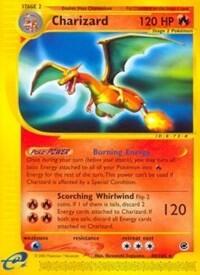
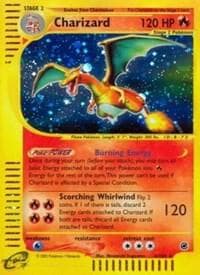
A dynamic Charizard pose set inside the e-Card frame, with the holo foil filling the art window. The card is a Stage 2 Fire type at 120 HP, with the Burning Energy Poke-Power and the Scorching Whirlwind attack. The defining visual quirk is the frame itself. The e-Card layout pushes the left and bottom borders out, which is what gives Expedition cards their famous off-center look. The dot-code strip you see on the coded commons does not appear on this holo.
Standard Expedition holo treatment. The holos, cards 1 through 32, carried no e-Reader dot code, so they were never swiped through the reader. That helped preserve their surfaces compared to the coded commons. The wide left and bottom borders are a manufacturing feature, not damage, and they are the reason centering grades vary so widely on this set.
It is the e-Card era's Charizard. Collectors who want one Charizard per generation reach for this card, and the iconic Pokemon plus a vintage holo finish and the quirky e-Reader-era frame make it stand out on a shelf.
BackgroundAbout Charizard
Charizard has been the face of the Pokemon TCG since the 1999 Base Set holo. Every era since has produced a Charizard that collectors chase, and Expedition is the one that opened the e-Card Series in 2002. It evolves from Charmeleon and Charmander, and the line has carried the franchise's identity for the better part of three decades.
- ›Charizard is the most collected Pokemon in the TCG by a wide margin
- ›First Charizard of the e-Card era gives it a clear place in any timeline
- ›Strong nostalgia for the early-2000s WOTC and e-Reader period
- ›Vintage holo that is still affordable raw compared to Base Set
- ›Recognizable instantly, which keeps demand broad across casual and serious collectors
- ›1999 Base Set Charizard, the card that set the standard for every Charizard chase that followed
- ›Neo and e-Card era Charizards that bridge vintage to the modern lineup
None today. This card is not legal in any current competitive format. Its Scorching Whirlwind attack and Burning Energy Poke-Power are pure vintage flavor now, and the value is entirely collector driven.
Own it wellCollector guide
Centering is the whole game on Expedition. The wide left and bottom borders make most copies look off-center, so judge centering carefully before you buy. Watch for the factory nicks this set is known for, especially on the back corners. Surface and edges on holos are often decent because the holos were never run through the e-Reader, but vintage whitening on the back edges is still common.
Grade it if you have a well-centered copy. The premium on this card lives at the top of the scale, so a clean Gem Mint candidate is worth submitting. A visibly off-center or nicked copy will not earn back grading costs, so be honest about centering first. For raw buying at any serious price, prefer cards already graded by a major company. Read the grading guide →
Standard vintage holo care. Penny sleeve plus a snug top loader, or a graded slab, kept out of direct light and away from heat and humidity to protect the holo layer and slow edge whitening. For long-term master-set storage, a rigid case beats a flexible binder page for a card this old. See the storage guide →
Buy the centering, not just the grade number. A centered NM raw copy can be more desirable than a higher graded but off-center slab. For serious money, buy graded from a reputable seller. Inspect back corners for factory nicks and confirm the holo presents cleanly under angled light. See the singles buying guide →
Expedition holos are vintage and worth basic authentication on bigger buys. Use the light test to check for the black core layer that real WOTC-era cards have. Feel the surface texture, watch how the holo behaves under angled light, and check the back swirl gradient for the genuine pattern. For any serious purchase, buying a card already graded by a major company is the safest route.
Protect your card
High Chase Score — protect and consider grading. · Amazon affiliate links · Storage guideWord on the streetCommunity sentiment
Collectors consistently call Expedition an overlooked set with strong production values, and this Charizard is its headline card. The common view is that it is one of the better-value vintage Charizards if you want an early-2000s holo without Base Set money. The recurring frustration is centering. People swap stories about how hard it is to find a copy that does not look off-center thanks to those wide borders.
Vintage collecting circles and set-registry communities treat Expedition as a sleeper, and the Charizard gets singled out as the piece worth chasing in top grade. The e-Reader experiment is a regular talking point, half novelty and half explanation for why the cards look the way they do.
Good to knowFrequently asked questions
Keep collectingRelated cards


Plan your Other Expedition master set
Track every card, see what you're missing, and lay out your binder page by page.