Rayquaza
Quick take
- Most valuable card in EX Emerald despite being a plain Holo Rare
- EX Emerald is the only EX-era main set with no Gold Star cards
- Kouki Saitou art plus Rayquaza's mascot status drive the demand
- A master set anchor: the copy you pick sets the tone for the binder
Collector's readWhat it means for your master set
Set landscapeWhere this card sits in EX Emerald
VariantsCard variants
Variants are the different finishes of the same card — the standard print, reverse holo, and any special patterns. A complete master set needs every variant below, so track each one in your collection.
| Variant | Note | Market |
|---|---|---|
| Reverse HoloScarcer 9/106 | Scarcer than the standard variant — the harder of the two for completers to find. | $799.99 |
| Holofoil 9/106 | Holofoil variant. | $431.32 |
| Normal 9/106 | Standard variant. | $400.00 |
The storyWhy this card carries the set
Most Holo Rares in a vintage set are filler you slot in and forget. Rayquaza is the exception in EX Emerald. The set has no Gold Stars, so the demand that would normally chase the shiniest pull lands here instead.
“Most valuable card in EX Emerald despite being a plain Holo Rare”
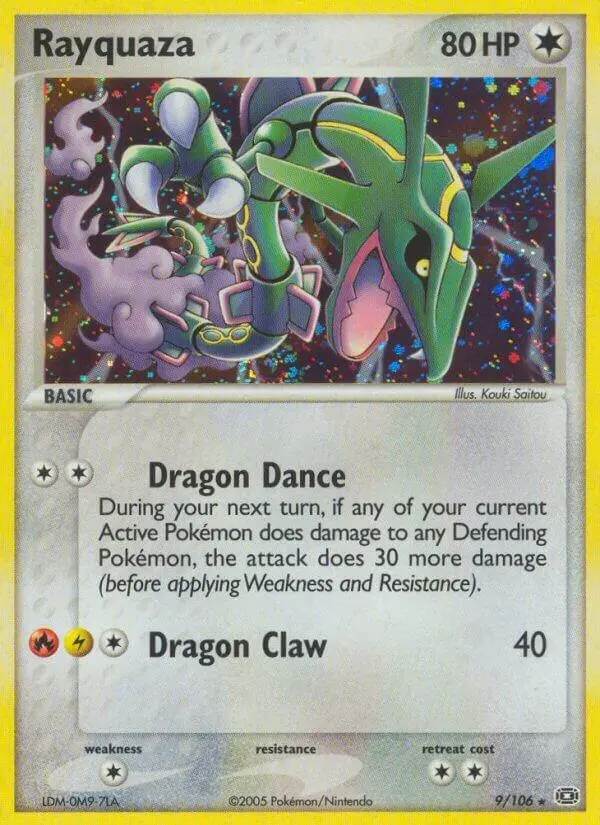
The card itself is a Basic Colorless Rayquaza with 80 HP and a retreat cost of two. Competitively it never mattered much. Collectors do not buy it for the attacks. They buy it because it is Rayquaza, drawn well, in a set where it is the best-looking thing in the box.
That is the whole story of this card's value. Right Pokemon, right moment, no Gold Star competing for attention.
By the numbersMarket analysis
This is the top card in EX Emerald, sitting above the boxed ex cards and the other holos. Raw near-mint copies trade in the strong vintage-single range, and gem-grade examples carry a heavy premium because they are scarce.
Vintage EX-era singles of popular legendaries have trended up over the last several years as the 2003 to 2007 window matured into a collected era. Rayquaza specifically benefits from steady mascot demand. Expect firm pricing on clean copies and volatility on raw listings where condition is hard to judge from photos.
Treat it as a blue-chip vintage single rather than a flip. The Pokemon is permanently popular and the supply is fixed. Condition is everything here, since 2005 holos surfaced with edge wear and print lines straight from the pack. A graded gem is the version that appreciates. Raw copies move with the broader vintage market.
The premium for a true gem grade is large because high-grade survivors are thin on the ground for a 2005 holo. Gem populations are small relative to how many copies exist, so mid grades and gem grades behave like two different markets.
Pull rate is not the scarcity that matters for this card. As a 2005 EX-era Holo Rare, Rayquaza came out of packs at normal holo odds, far more often than the era's Gold Stars. For context on the era, vintage Gold Stars were pulled at roughly one per two booster boxes, somewhere around one in seventy-two packs, and EX Emerald shipped with no Gold Stars at all. So the bottleneck today is not how often the card was pulled. It is condition. Twenty years of handling means clean, high-grade copies are the genuinely scarce part.
Against contemporary Gold Stars this is common out of the pack, but it tops EX Emerald specifically because the set has none of those marquee chases. Within the set it outranks the boxed ex cards on collector demand.
ArtworkWhy the art matters

Kouki Saitou has illustrated for the Pokemon TCG since the early 2000s and has drawn a long list of cards over the years. The style is realistic and dynamic, leaning on light, shadow, and dramatic camera angles to add motion. His legendaries tend to feel grounded rather than cartoony.
The card shows Rayquaza, the serpentine sky dragon, rendered in Saitou's realistic style against a holo background. The same artwork was used in Japan for the PokePark Blue Premium File, a promotional folder, which is a small detail collectors like to point to.
Standard EX-era holofoil on a Holo Rare frame, card number 9 of 106. Basic stage, Colorless type, 80 HP, retreat cost of two. The holo pattern is the flat sheet style typical of the era, which scratches easily and is a common reason copies grade low.
It is the rare case where a low-tier holo is the most wanted card in its set. The art is strong, the Pokemon is a fan favorite, and there is no flashier chase pulling attention away from it.
BackgroundAbout Rayquaza
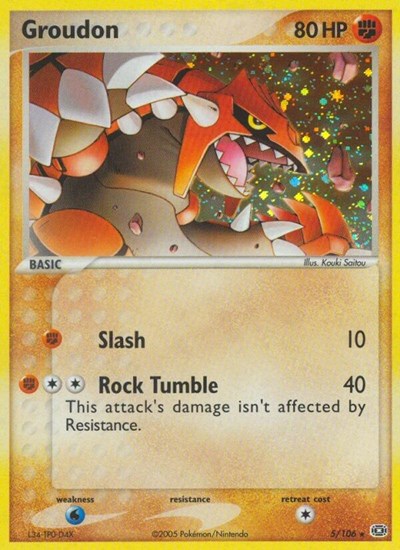
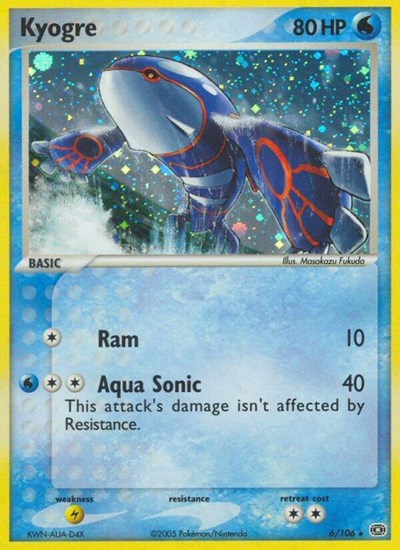
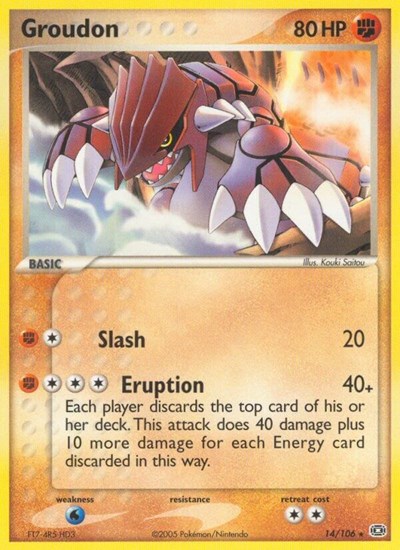
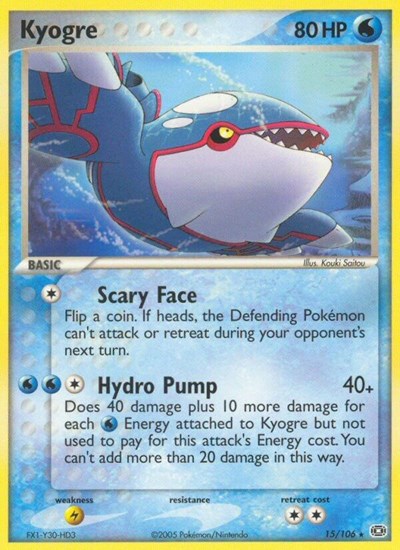
Rayquaza is the legendary dragon of the Hoenn region and the cover-tier mascot of Pokemon Emerald, the 2005 game this set was tied to. It sits in the weather trio with Groudon and Kyogre and has stayed near the top of fan-favorite lists ever since. That lasting popularity is the engine behind this card.
- ›Mascot of the Pokemon Emerald game the set launched alongside
- ›One of the most recognizable legendary dragons in the series
- ›Consistent collector demand across every era it appears in
- ›Distinctive serpentine design that artists render memorably
- ›Box-art legendary of Pokemon Emerald (2005)
- ›Member of the Hoenn weather trio with Groudon and Kyogre
- ›Recurring headline card across many later TCG sets
Own it wellCollector guide
This is a 2005 holo, so expect the usual vintage problems. Flat-sheet holo scratches, edge whitening, print lines, and soft corners are all common. Inspect the holo under angled light, since hairline scratches hide on the foil and tank a grade.
Worth grading if the copy is genuinely clean, since the gap between a mid grade and a gem grade is wide for this card. For a played copy, the grading fee rarely pays off. Grade the strong ones and keep the rest raw. Read the grading guide →
Sleeve and toploader at minimum. For anything you intend to grade or hold long term, use a penny sleeve plus a rigid holder, store it upright, and keep it out of heat and direct light. The era's holo finish scuffs easily in a binder, so handle by the edges. See the storage guide →
Decide on a grade first, then hunt. If you want one clean card for a master set, a graded copy in the grade you can live with removes the condition guesswork. If you are buying raw to save money, demand sharp angled-light photos of the holo and all four corners, and assume anything photographed flat-on is hiding scratches. See the singles buying guide →
Vintage Rayquaza cards are heavily faked, so verify before paying real money. Do a light test: a genuine card has the black core layer between the front and back, so very little light passes through. Check the surface texture and holo behavior against a known-good EX-era holo. Look at the back swirl gradient and color, which fakes often get wrong. For serious money, buy it already graded by PSA, CGC, or Beckett rather than raw.
Protect your card
High Chase Score — protect and consider grading. · Amazon affiliate links · Storage guideWord on the streetCommunity sentiment
Collectors consistently name Rayquaza as the card to chase from EX Emerald, and the set's lack of Gold Stars comes up almost every time it is discussed. The card is well regarded as a clean, classic legendary holo from the EX era.
- ›Gem-grade examples are scarce relative to total population, so high-grade sales draw attention when they surface
- ›Mid grades change hands far more often and at a fraction of gem money
Discussion tends to focus on two things: that EX Emerald is the oddball EX set with no Gold Star, and that Rayquaza is what saves it on the chase front. Renewed interest in the Rayquaza name across newer sets keeps the vintage card in conversation.
Good to knowFrequently asked questions
Keep collectingRelated cards


Plan your Other EX Emerald master set
Track every card, see what you're missing, and lay out your binder page by page.