Pokemon Center
Quick take
- Commemorates the November 2001 opening of the Pokemon Center New York, the first flagship store outside Japan
- Distributed in cello packs at the store and with online orders, not pulled from boosters
- Part of the 53-card Wizards Black Star Promo set, a popular vintage master-set target
- Unusual non-holo art with no featured Pokemon, valued on history and condition
Collector's readWhat it means for your master set
Set landscapeWhere this card sits in WoTC Promo
VariantsCard variants
Normal 40/132 · $850.00 — the only variant this card was printed in (no reverse holo or special pattern), so a master set needs just this one copy.
The storyA store opening turned into a vintage chase card
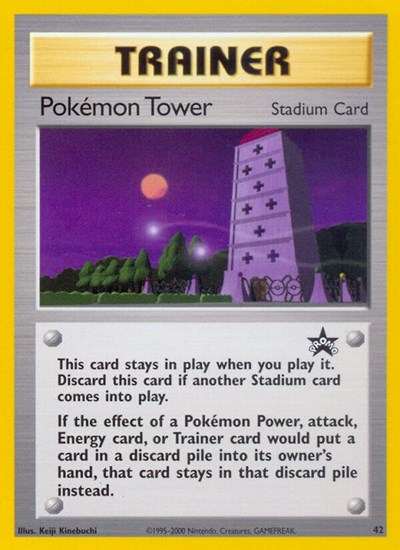
Pokemon Center #40 came out of the Pokemon Center New York opening in November 2001. It was handed out in cello packs that opening week, both in the store and with online orders. So the card is tied to a real place and a real moment, which is most of why people want it. The store later became the Nintendo World Store in the mid-2000s, so this card is one of the few physical things left from that original Pokemon Center.
“Commemorates the November 2001 opening of the Pokemon Center New York, the first flagship store outside Japan”
Mechanically it is a Trainer that wipes all your own damage counters, then makes you discard the Energy on those healed Pokemon. Nobody collects it for play. The pull is the WoTC era and the New York provenance. It sits in the 53-card Wizards Black Star Promo set, a popular master-set target on its own, and #40 is one of the harder numbers to close out in good shape.
What makes it strange is the art. No Pokemon front and center, no holo treatment, just a digital render of a store interior. Most vintage grails are holographic Charizards and the like. This one earns its spot on history and the scarcity of clean copies instead.
By the numbersMarket analysis
Pricing runs in the vintage-promo range rather than the four-and-five-figure holo territory. Clean ungraded copies are affordable by WoTC standards. High-grade slabs carry a real premium because so few survived in nice shape.
Values have tracked the broader vintage WoTC market, drifting up over the long run as sealed and clean WoTC material gets pulled out of circulation. It is not a hype card, so the moves are slow and steady rather than spiky.
Treat it as a steady vintage hold, not a flip. Demand comes from a fixed pool of WoTC and Black Star set builders, so liquidity is fine but not deep. The upside lives almost entirely in condition. A clean high-grade copy is the version with room to run.
High-grade slabs command a clear premium over raw, because surviving gem copies are scarce and the graded population is thin. Mid-grade and played copies trade much closer to the affordable end and are the practical pickup for set builders who just need the slot filled.
This is a giveaway promo, not a booster pull, so there is no pack pull rate. It came in cello packs handed out at the Pokemon Center New York opening in November 2001. Early collector lore pegged it at around 1,000 copies, but later digging turned that up. One collector found promotional material citing 5,000 available for online orders, plus the in-store handouts, which points to at least 10,000 produced and possibly more. So the card is one of the rarer Black Star numbers, but not genuinely scarce overall. The real scarcity is condition. Most surviving copies show creases or edge wear, which is why clean high-grade examples carry the premium. The graded population stays low for the same reason.
Think of it alongside the other store and event promos of the WoTC era rather than the holo creature chases. It is rarer than common Black Star numbers, but its overall supply is higher than the rarest WoTC giveaways. The grading population stays low mostly because people keep clean copies raw or sealed.
ArtworkWhy the art matters

Big Mama Tagawa illustrated a handful of WoTC-era Trainer and stadium cards. The work here is closer to a rendered scene than hand-drawn creature art, which fits a card built to document a real building rather than show off a Pokemon.
The card shows a computer-generated render of the second floor of the Pokemon Center New York, the area where visitors battled and traded. You get the store interior with its distinctive ceiling and a soft, bright palette. It reads as a place, not a battle scene, which is unusual for the era.
Non-holo promo printed on standard WoTC stock with the Black Star promo stamp and number 40. No reverse holo or alternate finish exists for this card, so condition and centering are the only variables that matter for grading.
Most WoTC chase cards lean on a famous Pokemon and a holo sheen. This one has neither and still gets chased. The appeal is documentary. It freezes a specific room in a specific store that no longer exists in that form.
BackgroundAbout Pokemon Center
There is no featured Pokemon on this card. It is a Trainer card depicting the Pokemon Center New York store itself. The broader Pokemon Center brand began in Japan, and the New York location was the first flagship store outside Japan. That history is what gives this card its weight.
- ›Tied to the first Pokemon Center flagship outside Japan
- ›A rare example of WoTC art documenting a real location
- ›Part of the collectible Wizards Black Star Promo run
- ›Nostalgia for the store that later became Nintendo World
- ›Distributed in cello packs during the Pokemon Center New York opening week in November 2001
- ›Listed as #40 in the 53-card Wizards Black Star Promo set
Own it wellCollector guide
Condition is the whole game here. The non-holo surface shows whitening on edges and corners fast, and many cello-pack survivors picked up creases over 20-plus years. Check centering front and back, look for surface scratches under angled light, and inspect the corners closely. A clean copy is worth chasing over a cheap rough one.
Grade if your copy is genuinely clean and well centered, since high-grade slabs are where the value sits and the population is thin. For a played or creased copy meant to fill a set slot, the grading fee usually is not worth it. Buy already-graded if you want a top-end example without condition risk. Read the grading guide →
Sleeve in a fresh penny sleeve inside a top loader or one-touch, kept out of direct light and away from humidity. As a non-holo vintage card it is prone to edge wear, so avoid loose binder pages that let it shift and rub. See the storage guide →
Decide your goal first. Set builders can grab an honest played copy cheaply and move on. If you want it as a centerpiece, hold out for a clean raw card you can grade, or buy a slab outright. Avoid overpaying for mid-grade raw copies listed at gem prices, which is a common trap on this card. See the singles buying guide →
Fakes exist for desirable WoTC promos. Verify the Black Star promo stamp and the #40 numbering, check the print and font crispness against a known-good scan, and confirm the back swirl color and gradient look right. Real WoTC cards pass the light test thanks to the inner black core layer. For any serious money, buy it already graded by a major company.
Protect your card
High Chase Score — protect and consider grading. · Amazon affiliate links · Storage guideWord on the streetCommunity sentiment
Vintage collectors treat it with a lot of affection. Some call it a holy grail for its New York provenance, even though cooler heads point out the print run is larger than the old 1,000-copy myth. The consensus is that it is desirable and historically interesting, with clean copies being the genuinely hard part.
Discussion centers on total supply and condition. Threads dig into how many were actually made, with collectors comparing notes on store handouts versus online orders. People also report stumbling on copies inside larger WoTC collection buys, which tempers the ultra-rare framing.
Good to knowFrequently asked questions
Keep collectingRelated cards


Plan your Promos WoTC Promo master set
Track every card, see what you're missing, and lay out your binder page by page.